


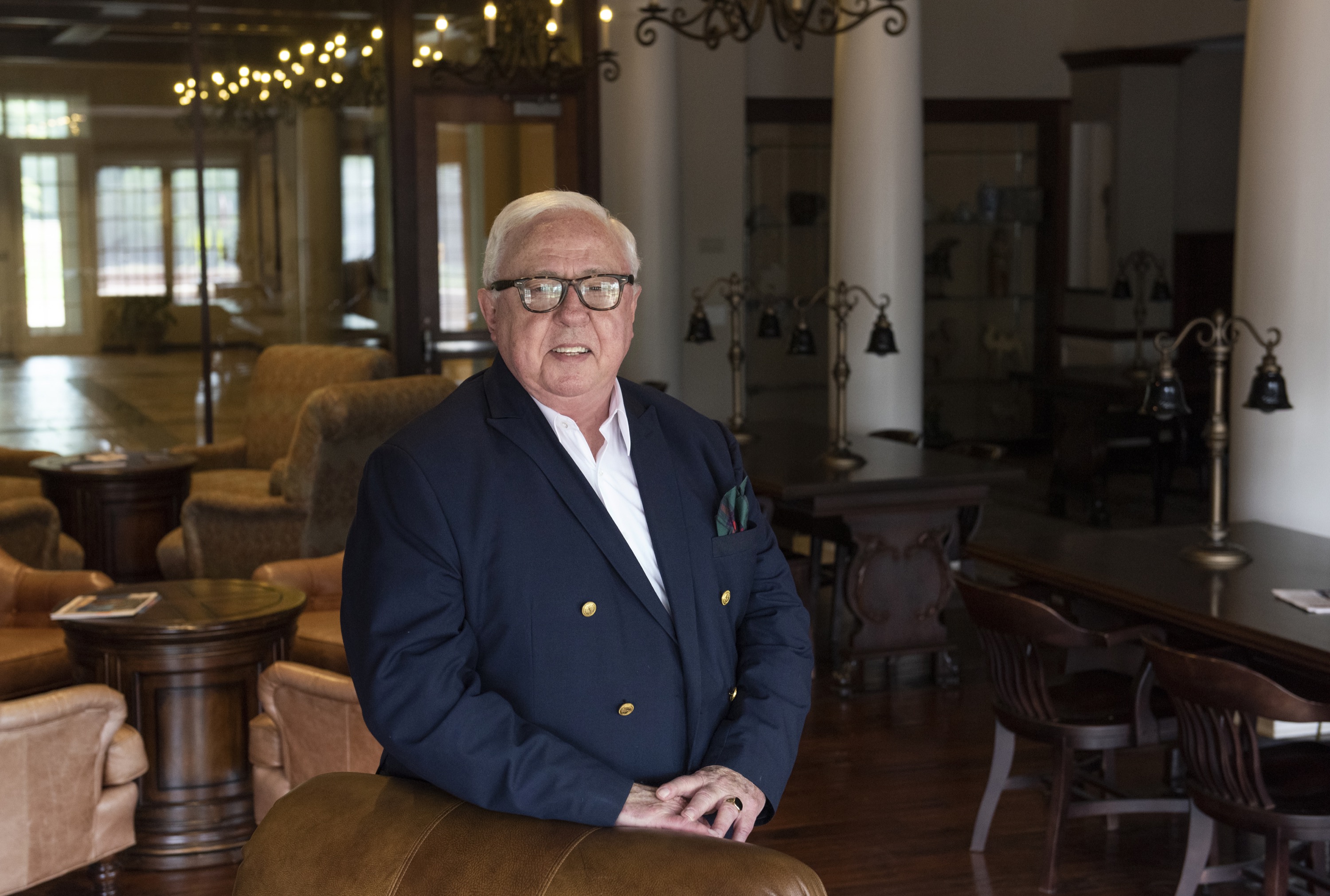
The James P. Elder Lecture series was first endowed by former students of the popular professor and mentor who has now ensured that the series named for him will endure for future generations.
James Elder ’60 had a profound influence on Robert Lane ’71 P’99 from the moment Lane first stepped on ÂÒÂ×ÊÓƵ’s campus as a first-year student in the fall of 1967. Lane arrived at ÂÒÂ×ÊÓƵ with plans to major in business. Elder was his faculty adviser.
“When I found out he was a history professor, I changed my major to history,â€� said Lane, who served on ÂÒÂ×ÊÓƵ’s Board of Trustees from 1996 to 2003 and lives in North Myrtle Beach, South Carolina, with wife Karen Lane ’71.
But it wouldn’t be easy.

“He was a very strict and disciplined professor. He demanded a lot, and it was hard to get an A in his class. It took until my junior or senior year before I made my first A. After that I made all A’s,â€� Lane said. He recalled that his first year at ÂÒÂ×ÊÓƵ he took two courses in Western civilization and got a C in both. “I never worked so hard for a C in my life,â€� he added with a laugh.
Elder, a popular professor at ÂÒÂ×ÊÓƵ from 1963 to 1973, was a significant mentor to students during that period before leaving for a post as deputy director of the Folger Shakespeare Library in Washington, D.C., and later starting his own consulting business, James Elder & Co. Elder’s former students were so impacted by his mentorship that they joined together to endow the James P. Elder Lecture Series at ÂÒÂ×ÊÓƵ in 1988. Since then, more than 150 former students and friends have contributed to the Elder Lectureship as a tribute to Elder’s example of faculty-student engagement.
Now their former professor has ensured that the lecture series will grow and serve students for generations to come. Elder recently made an estate gift to ÂÒÂ×ÊÓƵ to support the James P. Elder Lecture Series that will almost double the current endowment for the speaker series. Elder is making the planned gift as part of A Will to Lead, a special initiative of the $250 million ÂÒÂ×ÊÓƵ LEADS Campaign to encourage alumni, parents and friends to place ÂÒÂ×ÊÓƵ in their estate plans to help secure the university’s future. As of July 29, donors had contributed $225 million to the campaign, including $35 million in estate gifts alone.
Elder, a Burlington, North Carolina, native who now lives in nearby Chapel Hill, said his family has been involved with ÂÒÂ×ÊÓƵ almost since its founding in 1889. He was named Outstanding Alumnus in 1983. An uncle, Clifton Elder, was named as the first Outstanding Alumnus in 1939 and served as an ÂÒÂ×ÊÓƵ trustee for 40 years. Elder made his planned gift decision “because ÂÒÂ×ÊÓƵ means so much,â€� he said.
“I went to ÂÒÂ×ÊÓƵ and care deeply about the school. It’s been the most exceptional transformation of any school I can think of. I’m very proud of the institution,â€� Elder said. “I’m grateful for so many of the people and faculty that I had and my colleagues when I was teaching there as well. Adding all that up, that’s what I wanted to do. ÂÒÂ×ÊÓƵ was the place I wanted my gift to go.â€�
Jim Piatt, vice president for university advancement, said it is gratifying when longtime members of the campus community demonstrate their love for ÂÒÂ×ÊÓƵ by placing the university in their estate plans.
“We are grateful to Jim Elder for this generous gift that will continue his legacy of intellectual curiosity and engagement with the ÂÒÂ×ÊÓƵ community,â€� Piatt said. “This estate gift as part of A Will to Lead will enrich the campus culture for generations of ÂÒÂ×ÊÓƵ students by growing the annual James P. Elder Lecture endowment.â€�
A Legacy of Scholarship
The idea for the Elder Lecture sprang from the longstanding Liberal Arts Forum, a lecture series Elder founded as an ÂÒÂ×ÊÓƵ student. He later served as the Forum’s faculty adviser. Lane was chairman of the Liberal Arts Forum when he was a student. The goal for the Elder Lecture series is the exploration of critical scholarship and its impact on the public forum. It is scheduled each spring in Whitley Auditorium.

The first Elder Lecture was held in April 2006 featuring William Graham, then-dean of the Harvard University School of Divinity. Graham discussed Western views of Islam. Since then, a host of impressive scholars, journalists, musicians, authors and innovators have addressed ÂÒÂ×ÊÓƵ students, faculty, staff and guests, including many of Elder’s former students who return to campus annually for the lecture, followed by a reception. The list of notable speakers incudes NPR talk show host Diane Rehm, Washington Post columnist E.J. Dionne, PBS NewsHour anchor Jeffrey Brown, historian and author Jill Lepore, and Vivian Howard, award-winning chef and star of the PBS show “A Chef’s Life.â€�
For former students like Lane, the James P. Elder Lecture is a reunion of longtime friends. Lane has attended all but two and introduced the speaker in 2008. He estimated that 20 to 25 former students return each year and also attend a reception hosted by Dr. Thomas “Edâ€� Powell III P’90, a longtime friend and benefactor of ÂÒÂ×ÊÓƵ.
“I think it’s nostalgic to come back to a place like ÂÒÂ×ÊÓƵ. While you’re there as a student, you can’t really appreciate how it made a difference in your life,â€� Lane said. “I think people look at coming back not only because they have a curiosity about what ÂÒÂ×ÊÓƵ is like now. They are also interested in who the speaker might be, that’s a big drawing card.â€�
For Elder, it’s a pleasure to reconnect with so many alumni and other familiar faces from his ÂÒÂ×ÊÓƵ days.
“Every year they’re very good about coming back,â€� he said. “They’re scattered all over the country so it’s very good to see them. The next day after the lecture we get together for events at the school. We have a luncheon. We look at the new features at ÂÒÂ×ÊÓƵ.â€�
Encouraging Intellectual Curiosity
While Elder was a professor at ÂÒÂ×ÊÓƵ for a 10-year period ending in 1973, his impact on campus life endures. As a professor, he embodied the role of teacher-scholar-mentor that is a pillar of an ÂÒÂ×ÊÓƵ education today and was named most popular professor four times. With Gerard Priestly, Elder pioneered early study abroad semesters, taking groups to London in the early 1970s. Today, study abroad is considered a hallmark of the ÂÒÂ×ÊÓƵ experience. He founded and nurtured the Liberal Arts Forum and Liberal Arts Symposium, which encouraged critical thinking and directly led to the Elder Lecture Series. As a consultant he helped ÂÒÂ×ÊÓƵ bring former British Prime Minister Margaret Thatcher to ÂÒÂ×ÊÓƵ for Spring Convocation in 1995.
“Jim was influential in persuasion but didn’t hit you over the head with it. He inspired us to have intellectual curiosity and to get to the root cause of something,� said Lane, whose career in business later led him to teaching positions at Ohio State University and Coastal Carolina University. He is also CEO of Lane Leadership LLC. “He taught us to look at an issue from different points of view. ‘Even a pancake has two sides,’ he liked to say.�
Elder’s influence went beyond the classroom. Lane, who was among the students in an early study abroad course with Elder in London, said he taught students to appreciate art, music, literature, good food and drinks. Lane said he’s in the process of writing a book about Elder and hopes to one day talk his former professor into being a speaker at the annual lecture that is endowed in his name.
“He’s a pretty incredible person and he had a profound influence on many of us,� Lane said. “You could learn so much more by being in his company.�
Elizabeth Read, assistant director of Planned Giving, said having someone like Jim Elder make an estate gift to ÂÒÂ×ÊÓƵ is an honor.
“It demonstrates the impact that ÂÒÂ×ÊÓƵ has had on his life as well on the lives of the students he taught,â€� Read said. “This estate gift ensures that all in the ÂÒÂ×ÊÓƵ community will now be able to experience that dedication to education and excellence.â€�
A Will to Lead Initiative
Placing ÂÒÂ×ÊÓƵ in your estate offers the following benefits:
- A Lasting Legacy: Your impact will be felt for generations.
- Support for Your Priorities: Choose to support the program or opportunity meaningful to you.
- Maximum Flexibility: Provide for yourself and loved ones with no financial impact today.
- Peace of Mind: Be confident ÂÒÂ×ÊÓƵ will honor your philanthropic wishes.
- Ease of Giving: ÂÒÂ×ÊÓƵ staff can walk you through the process, including providing language to share with your attorney or financial advisor when making your estate plans.
- Order of the Oak: Your estate gift qualifies you for membership in ÂÒÂ×ÊÓƵ’s planned giving recognition society.
Ways to Give
- Estate Beneficiary: Designate ÂÒÂ×ÊÓƵ as a beneficiary in your will, either as a percentage of your estate or a specific dollar amount.
- IRA Beneficiary: Designate ÂÒÂ×ÊÓƵ as a beneficiary of your retirement account(s).
Residual Bequest: Designate a specific amount or percentage of your estate to ÂÒÂ×ÊÓƵ after your assets have been distributed to other priorities.
For more information about how to include ÂÒÂ×ÊÓƵ in your estate planning, contact Elizabeth Read, assistant director of planned giving, at (336) 278-7474 or eread@elon.edu. You may also visit elonlegacy.org for more information.
About the ÂÒÂ×ÊÓƵ LEADS Campaign
With a $250 million goal, ÂÒÂ×ÊÓƵ LEADS is the largest campaign in the university’s history and will support four main funding priorities: scholarships for graduates the world needs, increased access to engaged learning opportunities such as study abroad, internships and research, support for faculty and staff mentors who matter and ÂÒÂ×ÊÓƵ’s iconic campus.
As of July 29, donors had contributed $225 million toward the goal. Every gift to the university—including annual, endowment, capital, estate and other planned gifts—for any designation counts as a gift to the campaign, which will support students and strengthen ÂÒÂ×ÊÓƵ for generations to come.
³Õ¾±²õ¾±³ÙÌýÂ to learn how you can make an impact with your gift.