


An ÂÒÂ×ÊÓƵ Poll finds a sharp decline in confidence that the nationwide vote count will be accurate this fall, alongside a bipartisan consensus against federalizing election administration.
As North Carolina gears up for the 2026 mid-term elections, a new ÂÒÂ×ÊÓƵ Poll reveals former Democratic Gov. Roy Cooper holding a wide name recognition advantage in the U.S. Senate race, while voters statewide express significant and growing uncertainty about the electoral process itself.
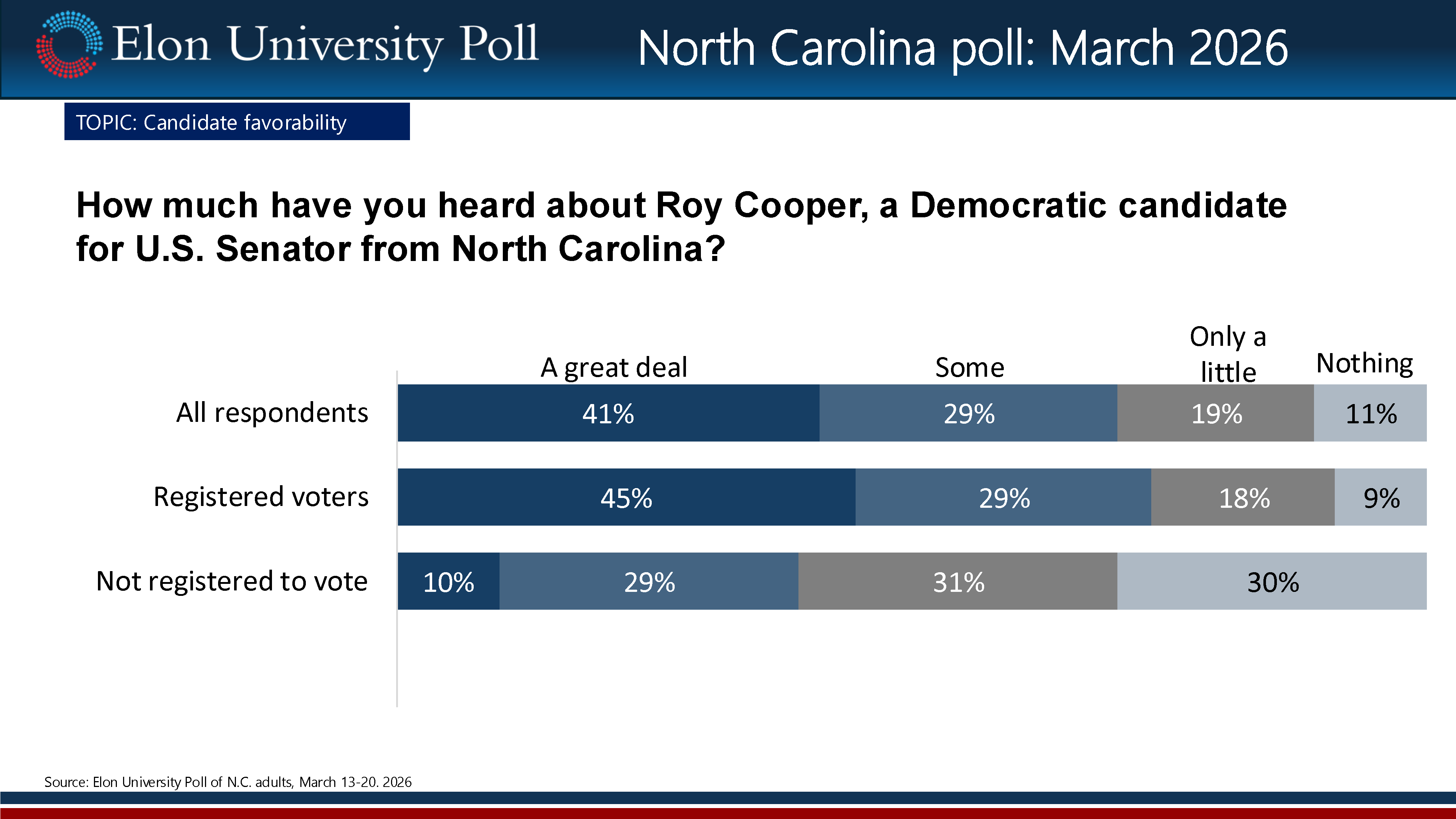
In a survey of 800 North Carolina adults conducted from March 13 to 20, 2026, 70% said they have heard a “great deal” or “some” about Cooper, compared to just 35% who have heard the same amount about his Republican opponent, Michael Whatley.
Whatley, who formerly served as chair of the Republican National Committee and the North Carolina Republican Party, remains largely unknown to registered voters. Nearly two-thirds of respondents (62%) said they have heard “only a little” (33%) or “nothing” (29%) about him.
When asked about their overall impressions, 48% of registered voters viewed Cooper favorably and 34% unfavorably. For Whatley, 25% of registered voters viewed him favorably, 34% unfavorably and a plurality of 41% hold a neutral opinion.Ìý
Election fairness and administration
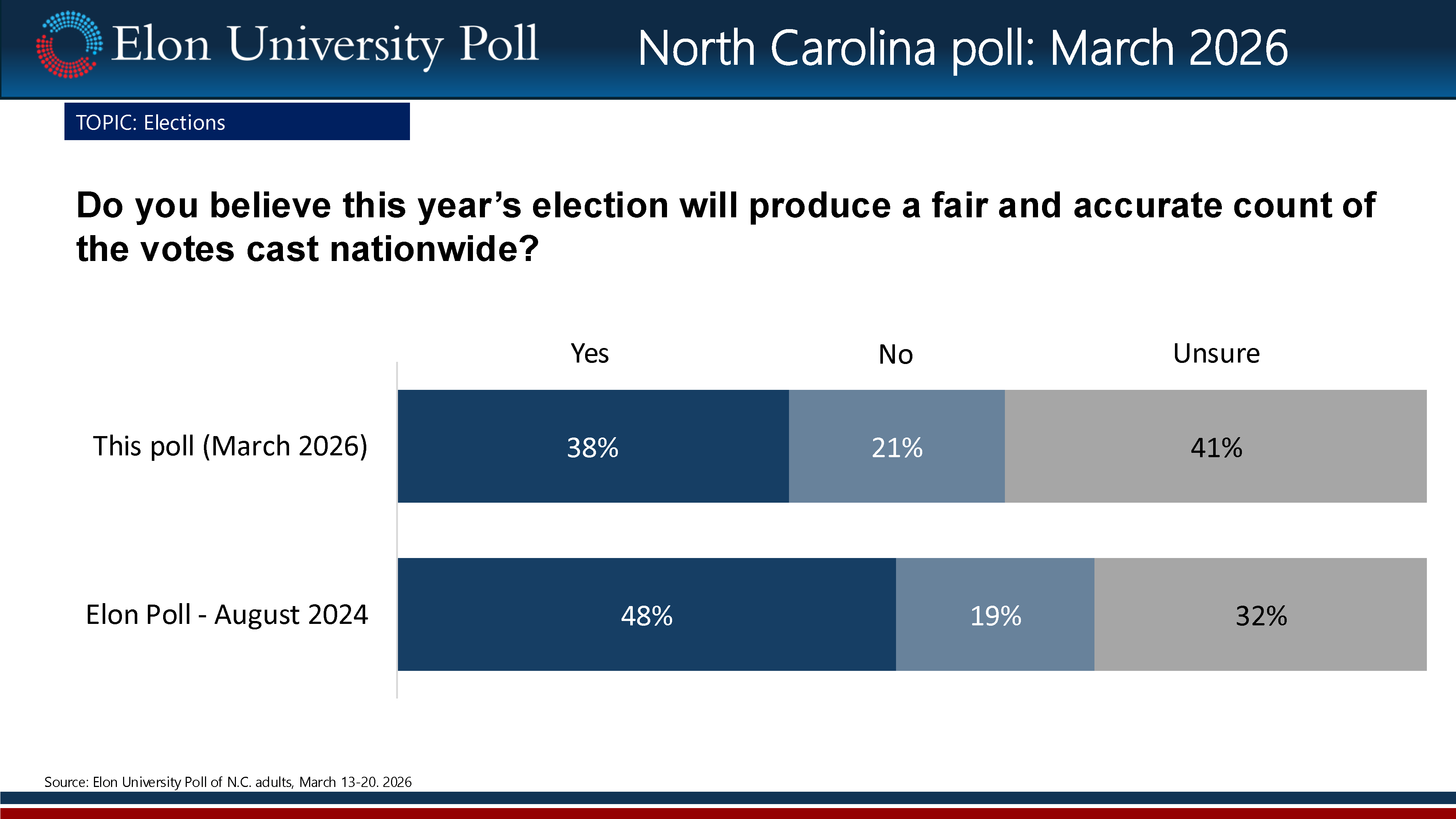
Looking ahead to the fall mid-terms, the poll highlights a striking drop in public confidence regarding the integrity of the national vote count. Only 38% of North Carolinians said they believe this year’s election will produce a fair and accurate count of the votes cast nationwide.
While only 21% explicitly said the count willÌýnotÌýbe fair, a sizable 41% of voters said they are “unsure.” This represents a significant decline in confidence from an ÂÒÂ×ÊÓƵ Poll conducted in August 2024, when 48% believed the count would be fair and accurate, and 32% were unsure.
Despite this growing uncertainty, North Carolinians fiercely oppose the idea of the federal government taking over election administration. When asked if election administration should remain a state government responsibility or change to a federal responsibility, 63% of residents said it should remain with the states. Only 12% support nationalizing voting processes, while 25% are unsure.
The preference for state-run elections crosses party lines: 79% of Democrats, 56% of Republicans, and 53% of Independents all agreed that state governments should retain primary responsibility for election administration within their borders.
“While the U.S. Senate race continues to take shape around a major gap in voter familiarity with the candidates, a broader story emerging from the 2026 election is how North Carolinians view the electoral process itself,â€� said Jason Husser, director of the ÂÒÂ×ÊÓƵ Poll. “North Carolinians are increasingly anxious and uncertain about whether the national vote count will be fair, even more than they were in the contentious 2024 election. Yet, most voters do not see federal intervention as the solution. Rather, we measured a strong, bipartisan consensus that election administration belongs in the hands of the states.â€�
Regarding the partisan balance of power, voters currently show a slight preference for Democratic control of Congress. Forty percent of respondents favored Democratic to control of both the U.S. Senate and the U.S. House of Representatives after the 2026 elections, compared to 35% who preferred Republican control.
State approval ratings and policy issues
The poll also surveyed North Carolinians on state leadership and several hot-button policy issues:
- Approval Ratings:ÌýDemocratic Gov. Josh Stein received a positive job approval rating (43% approve, 27% disapprove). By contrast, the North Carolina General Assembly earns lower marks, with just 21% approving of the legislature’s job performance and 37% disapproving (42% are unsure).
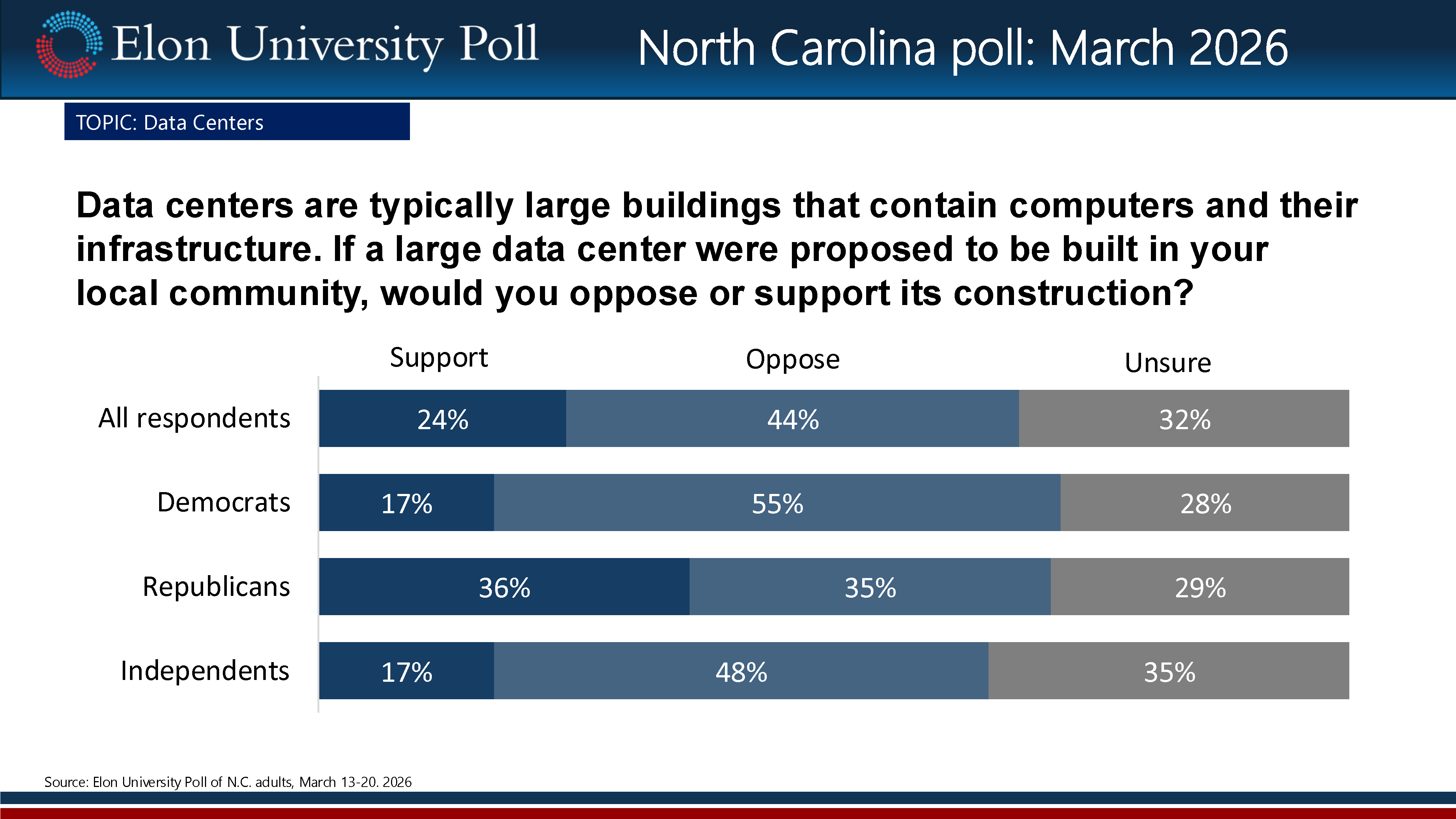
- Data Centers:ÌýAs technology infrastructure expands globally, 44% of residents said they would oppose the construction of a large data center in their local community, compared to 24% who would support it and 32% who were unsure.
- Concealed Carry Permits:ÌýThe General Assembly has recently considered allowing concealed carry of handguns without a permit. A clear majority of North Carolinians (56%) said they oppose removing the permit requirement, which currently involves a fee, safety training and a background check. Only 30% supported removing the requirement. These numbers reflect slight change from a that found 54% opposed to removing the requirement.
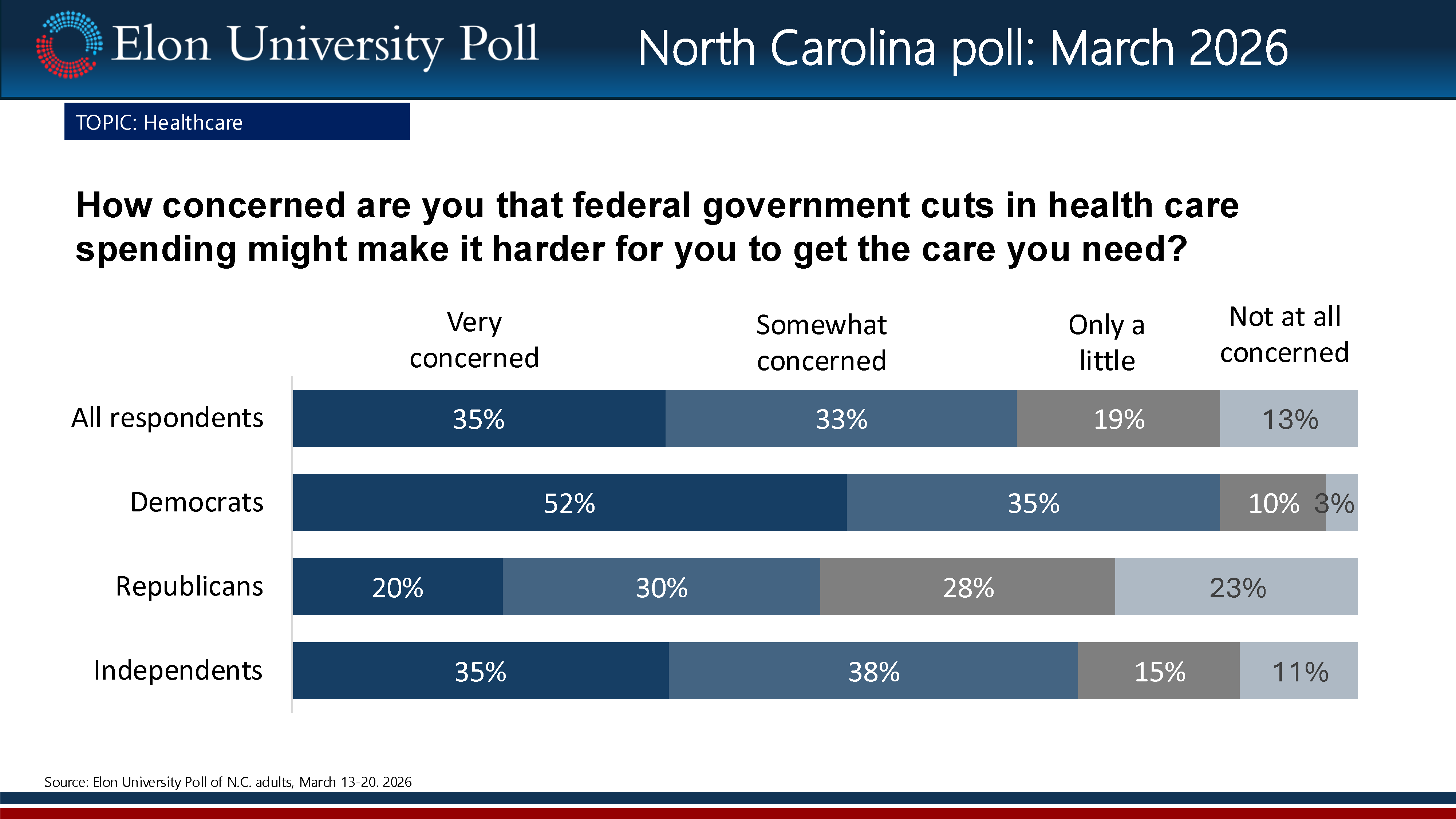
- Healthcare:ÌýA large majority (68%) said they are “very” or “somewhat” concerned that federal government cuts in health care spending might make it harder for them to get the care they need. Furthermore, 47% of respondents grade the U.S. healthcare system with a “D” or “F,” while 30% give it a “C.”
- Economy: Opinions about the North Carolina economy remained virtually unchanged compared with the September 2025 ÂÒÂ×ÊÓƵ Poll, with 29% giving the state’s economic condition an “Aâ€� or “Bâ€� and 71% giving it a “C,â€� “Dâ€� or “F.â€�
Poll Methodology
Access the poll topline and methodology at:Ìý. The survey was developed by the ÂÒÂ×ÊÓƵ Poll and fielded by the international marketing and polling firm YouGov as an online, web-based survey, self-administered with online panels. Between March 13 and March 20, 2026, YouGov interviewed 928 North Carolina adults aged 18 and older. These respondents were then matched down to a sample of 800 to produce the final dataset.
The matched cases were weighted to the sampling frame using propensity scores based on age, gender, race/ethnicity, years of education, and home ownership. The margin of error for this poll (adjusted for weights) is +/-4.43%.
About the ÂÒÂ×ÊÓƵ Poll
Established in 2000, the ÂÒÂ×ÊÓƵ Poll conducts national and North Carolina surveys on issues of importance to voters and residents. Information from these polls is shared with media, citizens and public officials to facilitate informed public policy making through the better understanding of citizens’ opinions and attitudes. The poll is fully funded by ÂÒÂ×ÊÓƵ and operates as the neutral, non-biased information resource.
The ÂÒÂ×ÊÓƵ Poll is a charter member of theÌý, a program created by the American Association for Public Opinion Research (AAPOR) in 2014 to educate polling firms on ways to better share how they collect and interpret their information. The ÂÒÂ×ÊÓƵ Poll’s voluntary participation in this initiative signifies a willingness to clearly state in its reports how questions were asked, in what order, who funded the poll and then conducted it, and a definition of the population under study, among other details.