2025-2026 Inclusive Excellence Report
(Based on the objectives established in the School of Communications Diversity, Equity and Inclusion Plan, which guides our inclusive excellence goals and efforts since AY 2023-2024).
Prepared by: Professor Vanessa Bravo
This report includes the following content:
- The most-recent School of Communications Diversity, Equity and Inclusion Plan (from now on, SOC DEI Plan, in place since academic year 2023-2024), linked here.
- A section with the School of Communications (SOC) inclusive excellence outcomes for the 2025-2026 academic year, based on the main areas presented in the SOC DEI Plan:
– Inclusive Curriculum
– Student Recruitment & Retention
– Diverse & Culturally Proficient Faculty
– Inclusive Climate
– Communications - An Appendix section with the school’s 2025-2026 Inclusive Excellence Faculty Activity Report.
School of Communications Inclusive Excellence Outcomes for Academic Year 2025-2026
The current SOC DEI Plan, approved by the faculty in academic year (AY) 2023-2024, continues to guide the school’s goals and efforts for AY 2025-2026. The following report details the inclusive excellence outcomes achieved in this academic year.
Inclusive Curriculum
The School of Communications intentionally infuses content that is centered on inclusive excellence in its curricular offering through required and elective courses, experiential learning opportunities for its students, diverse guest speakers and classroom activities, as described next.
The SOC has inclusive excellence-related objectives in many required courses (as shown below) but it also has developed a dedicated course in 2023 focused solely on inclusive excellence: COM 2000 Inclusive Communications. The description and student learning outcomes (course objectives) of this course are the following:
COM2000 Inclusive Communications
Course Description:
- “This course is an introduction to foundational social and theoretical communication concepts related to diversity, equity and inclusion. You will practice interpersonal, small group, and written communication skills essential for advocating, participating, and leading in today’s global workplaces. Students will explore how mass media and social media helps construct notions of social reality, with a focus on media representations of marginalized groups in the United States and globally.�
Goal:
- “To equip students with knowledge and skills to advocate for and understand the value of diversity, equity and inclusion.�
Student Learning Outcomes:
- develop awareness and appreciation for diverse peoples and cultures.
- explain the concepts of diversity, equity, and inclusion in collaborating with and advocating for diverse and inclusive teams.
- recognize the validity of differing perspectives in ethical reasoning and decision-making.
- consider issues of identity within the context of media, including stereotypes, ownership, power, and audience perception.
- »å±ð³¾´Ç²Ô²õ³Ù°ù²¹³Ù±ðÌýculturally proficient communicationÌý¾±²ÔÌýwriting and speaking to and about diverse global audiences.
AER-Approved Courses at the SOC
In AY 2025-2026, the SOC offered, for the first time, an elective course that fulfills the university’s Advancing Equity Requirement (AER). Developed by assistant professor Karen Lindsey, the 4-credit class, STC 3710 Strategic Communications and Social Change, was offered in the Fall of 2025. Twenty-eight students took the class (which is capped at 33 students). This course was offered again in the Spring of 2026, and it was full, with 33 students registered. The description and objectives for this class are as follows:
Description:
The course explores how strategic communications is used in advocating for, shaping, and influencing social change in the United States. Specifically, the course addresses how communication through advertising, television, cinema, journalism, corporate communications, and sports have been essential in the quest for social change. The course examines historic and contemporary social justice movements, explores systemic power in communication disciplines, and analyzes outcomes of various movements that spurred change in the United States. Case studies in this course will be refreshed as contemporary issues and relevant topics emerge in the field of communications and in society.
Student Learning Outcomes
- Students will evaluate the historic, cultural, and societal causes of structural racism and how mass media and social media have used activism and advocacy to communicate about social movements.
- Students will interrogate their positionality as they consider their various forms of communication consumption, engagement, and influence in social movements.
- Students will explain how racial inequities are interwoven in US systems including media coverage of education, government, policing, healthcare, and how the media perpetuates or dismantles inequalities.
- Students will apply real and/or theoretical solutions to create a discipline-based project focused on advocacy on behalf of a group with intersectional identities or social cause that addresses inequality.
In AY 2025-2026, the Strategic Communications Department added a second course that fulfils ÂÒÂ×ÊÓƵ’s AER requirement. The course is called STC 3702 Brand Activism & Advocacy, it was developed by assistant professor Shanetta Pendleton, and it was successfully offered in WT2026. An additional section was offered in the Summer II term, in July of 2026. The description and student learning outcomes for this class are the following:
Description:
This course explores the evolving role of corporations in social advocacy and activism, examining how organizations communicate their values, respond to societal issues, and navigate the risks and rewards of taking public stances. Students will analyze case studies, critique brand-led campaigns, and explore the ethical, strategic, and reputational implications of corporate social advocacy (CSA). Emphasis will be placed on understanding stakeholder engagement, authenticity, media framing, and the intersection of corporate communication with movements for social change.
Student Learning Outcomes
Students will be able to:
- Define corporate social advocacy (CSA) and differentiate it from related practices such as corporate social responsibility (CSR).
- Analyze how their own racial, gendered, and cultural identities shape their perceptions of power, voice, and representation within institutional contexts. [LO1]
- Explain how intersectional identities (e.g., race, gender, class, sexuality, religion) are socially constructed and maintained through corporate and media systems [LO2].
- Trace the historical, cultural, and structural roots of inequities within corporate communication, branding, and workforce representation [LO3].
- Analyze motivations and risks behind corporate activism.
- Evaluate brand-led campaigns for authenticity and impact.
- Examine stakeholder influence and media framing.
- Apply qualitative methods to analyze campaign reception.
- Develop a strategic advocacy communication plan that addresses a brand’s crisis or reputational challenge through the lens of racial equity and inclusion. [LO4]
One more class in the SOC that is AER-designated is Associate Professor Jane O’Boyle’s section of STC 4970 Great Ideas in Strategic Communications.
Other SOC Required Courses with Inclusive Excellence Objectives
In alignment with the Accrediting Council on Education in Journalism and Mass Communications (ACEJMC)’s Accreditation Standard 4, Advancing a Culturally Proficient Workforce, other required courses in each of the SOC majors and in the SOC’s Core Curriculum include inclusive excellence student learning outcomes (course objectives).
In the COM Core Curriculum:
COM 1000 Communications in a Global Age
- identify significant milestones and individuals in the multicultural history of communications.
- define “audience� and describe examples of media content tailored to reach diverse domestic and global audiences.
In Cinema and Television Arts (CTA)
CTA 2100 Introduction to Cinema and Television Arts
- reflect on how cinema & television are tools of communication and can facilitate the understanding of domestic, global and diverse cultures.
- write and speak clearly and effectively to critically evaluate one’s own viewing habits, preferred genres, and biases.
CTA 3260 Cinema Production
- understand and incorporate best practices of diversity, equity and inclusion including an emphasis on supportive and equitable working environments.
CTA 3240 Studio Variety Reality TV Production
- understand and incorporate best practices of diversity, equity and inclusion on set and in creative works
CTA 4550 Advanced Documentary and Non-Fiction Production
- critique content for aesthetic value while considering diverse domestic and global audiences.
understand and incorporate best practices of diversity, equity, and inclusion, including an emphasis on supportive and equitable working environments.
CTA 4550 Advanced Narrative Production
- critique content for aesthetic value while considering diverse domestic and global audiences.
understand and incorporate best practices of diversity, equity, and inclusion, including an emphasis on supportive and equitable working environments.
CTA 4974 Entertainment Media Issues and Research
Course Description:
-  “In this senior level course, students use sound research methodologies to offer solutions to contemporary issues related to systemic racism and other inequities through the lens of the entertainment industry. To accomplish this goal, students will examine scholarship focused on race, intersectionality, media representations, onset production cultures, content distribution, and exhibition. Students will gain an understanding of how equitable practices in the industry can influence the success of media production and consumption. In addition, students will learn how entertainment content can serve as an educative tool for media consumers. Senior Standing Required
Student Learning Outcomes:
- use clear and effective writing to assess the relationship between your racial and other identities and the entertainment industry both as a consumer and as a professional.
- conduct historiography and case study research to assess the structures and systems that shaped the multicultural history and roles of media in society.
- apply qualitative and quantitative research methods to assess diverse representations in front of and behind the screen
- examine how images in the entertainment industry reflect issues related to the state of race and racism in the US
- assess content or textual analysis to understand current trends in the depiction of race and intersectional identities in current entertainment content
- recommend or advocate for racial and intersectional equity in entertainment media organizations and/or teams in a well sourced paper or project.
In Communication Design (CDE)
CDE 2580 Principles of Communication Design
- consider how visual components influence the perception of media messages and impact diverse domestic and global populations.
- describe how issues relevant to freedom of expression and ethical ways of reasoning influence the practice of visual communications.
CDE 4580 Design Strategies and Solutions
- use advanced design theories and methodologies to produce professional-quality content that targets a specific audience.
- engage in advanced levels of research and analysis to deliver professional-level solutions to clients, key stakeholders, and specific, targeted audiences.
In Journalism (JOU)
JOU 1100 News Writing and Reporting
- gather information from diverse sources and critically evaluate the credibility of sources.
- further develop awareness of ethical ways of reasoning and professional writing standards in matters such as truth, accuracy, fairness, objectivity, diversity and meeting deadlines.
- compare and contrast writing for different audiences, different media and across multimedia platforms.
JOU 2500 Journalism in a Free Society
- explain the contributions of domestic and global diversity to the evolution of journalistic practice.
- evaluate reporting on race and intersectional identity, as well as historical, cultural, and societal causes of systemic and structural inequity.
JOU 3100 Reporting for the Public Good (elective course, not included in the grid)
- further develop awareness of ethical ways of reasoning and professional writing standards in matters such as truth, accuracy, fairness, inclusive excellence, and timeliness.
- write clearly, accurately, and effectively, and with a sense of serving the public good. This includes serving a wide range of people across our society and being alert and committed to issues of free expression, social justice, and equity.
- reflect on and articulate the community-building function of news, and your place in it.
JOU 3150 Digital News Production
- assess how technology in news can affect diverse groups, such as sampling issues with social media, effect of lighting on skin tones, algorithmic bias, and disability access.
JOU 4500 Multimedia Journalism (elective course, not included in the grid)
- engage in ethical ways of thinking and apply professional standards, such as truth, fairness, accuracy and attention to diversity of audiences.
JOU 4970 Investigative Journalism
- plan and produce multimedia reporting projects using data, diverse sources, public records, and the tools of technology
- review the history and roles of investigative reporting in journalism, comparing the levels of diversity in historic news reporting with modern reporting.
In Media Analytics (MEA)
JOU 1100 News Writing and Reporting
- (see SLOs listed above, under “In Journalism�)
MEA 2600 Media Analytics I
- explain demographic and psychographic variables that are traditionally used to describe media audiences.
- explain strategies used by the creators of media messages to appeal to large and specialized audiences, including diverse domestic and global populations.
MEA 4100 Communicating Media Insights
- interpret complex media analytics to provide insights and make recommendations to guide informed decisions for communicating with diverse domestic and global audiences
In Strategic Communications (STC)
JOU 1100 News Writing and Reporting
- (see SLOs listed above, under “In Journalism�)
STC 2520 Foundations of Strategic Communications
- understand issues of diversity, equity and inclusion (DEI) in the United States, historically and currently, and their impact in the practice of the strategic communications professions today.
- demonstrate an awareness of domestic and global diversity with internal and external audiences.
- recognize the impact that lack of diversity in strategic communications and within working teams can have in the real world, including reputation damage, crises and financial losses.
STC 3120 Strategic Writing
- demonstrate writing and presentation techniques that pertain to diverse domestic and global audiences, media and messages.
- create culturally appropriate content targeted to different communities/groups, according to their information needs, that considers DEI.
STC 3620 Strategic Research Methods
- understand the impact of DEI (or lack thereof) in the research process, and apply this understanding to research ethics, design, instrument selection, data-collection, analysis and synthesis of results, and production of written and oral reports
STC 4520 Strategic Campaigns
- demonstrate cultural proficiency and awareness about diversity, equity, and inclusion in the preparation of strategic campaign materials.
- understand the value of working with diverse teams and of advocating for diverse teams in your profession to develop strategic campaigns.
- articulate the business case for incorporating DEI in the strategic communications and within the teams that develop those communications, in the U.S. context and internationally.
Finally, it is relevant to mention that the SOC oversees two interdisciplinary minors where inclusive excellence goals and objectives are also included in the course offerings: the Global Film and Cultures minor and the Health Communications minor.
School of Communications Experiential Learning Opportunities
Some of the experiential learning opportunities that the School of Communications students had in 2025-2026 were the following:
Study abroad:
In January 2026, the following SOC faculty led or co-led study abroad courses:
- Dr. Sydney Nicolla and assistant professor Max Negin led the Holocaust Journey study abroad course in Europe;
- Dr. Alex Luchsinger and Dr. Khirey Walker co-taught a course on sports and ESPN in Brazil;
- Dr. Cara Lucia co-led a course about baseball in the Dominican Republic;
- Dr. Vanessa Bravo co-led a study abroad course about language, culture and ecotourism in Costa Rica;
- Dr. Young Do Kim taught the course Business, Culture, and Economics in East Asia, which explored the transformation of East Asia, focusing on South Korea and Japan.
Study away:
- Assistant Professor Ahmed Fadaam led a study away course to the Sundance Film Festival in Utah, and to Los Angeles.
Undergraduate research:
Students conducted undergraduate research that involved issues connected to inclusive excellence in many ways, from research projects in capstone courses to mentored research experiences with individual faculty members. Some research projects focused on inclusive excellence topics that resulted in conference presentations, refereed exhibitions, selection for external awards, or peer-reviewed publications were the following:
Published in the ÂÒÂ×ÊÓƵ Journal of Undergraduate Research in Communications (“ÂÒÂ×ÊÓƵ Journalâ€�).
Spring 2026
- TikTok in Tragedy: Exploring Online Sensemaking and Emotional Responses to the Idaho College Student Murders. By Kyra Briggs. Mentor: Daniel Haygood.
- Mammy to Multidimensional: Analyzing the Representation of the Strong Black Woman Archetype in American Drama Television Series from 1980 to Present Day. By Evelyn Ealey. Mentor: Daniel Haygood.
- Unnaturally Perfect: An Analysis of TikTok’s “Clean Girl Aesthetic� and Its Connection With Young Women Aged 18-25. By Avery Ferguson. Mentor: Daniel Haygood.
- Beyond the Medium: An Analysis of Transgender Representation in Children’s Serialized Animated TV Shows in the United States. By Jenna Moylan. Mentor: Jessalynn Strauss.
- 2016 Was the Best Year and I Will Die on this Hill: Gen Z Nostalgia, Meme Culture, and Emotional Memory. By Elizabeth Walker. Mentor: Laura Lacy.
Fall 2025
- More Than the Music: An Analysis of Kendrick Lamar’s Super Bowl Halftime Show as Symbolic Protest and Political Resistance. By Caroline Bienfang. Mentor: Daniel Haygood
- Restricted Reading: How K-12 Educators Experience and Perceive Book Bans. By Audrey Geib. Mentor: Glen Scott.
- Framing Sisterhood: Media Portrayals of Alpha Kappa Alpha Sorority in the 2024 Election. By Angelina Giallella. Mentor: Jane O´Boyle.
- Parental Overshare: The Exploitation of Vulnerable Individuals by Parents on Social Media. By Angela Pecora. Mentor: Daniel Haygood.
- A Special Interest in Spontaneity? Newsroom Experiences of Journalists with Autism Spectrum Disorder and How Employers Can Accommodate. By Betsy Schlehuber. Mentor: Daniel Haygood.
Poster presentations during SURF DAY (April 28, 2026)
- Beyond the Medium: An Analysis of Transgender Representation in Children’s Serialized Animated TV Shows in the United States of America. Jenna S. Moylan (Dr. Jessalynn Strauss). Department of Strategic Communications.
- Recognizing K-Beauty: Consumer Perceptions of Korean and U.S. Skincare Packaging. Ellie Dugan (Dr. Shannon Zenner). Department of Communication Design.
- Mammy to Multidimensional: Analyzing the Representation of the Strong Black Woman Archetype in American Drama Television Series from 1980 to Present Day. Evelyn Ealey (Dr. Daniel Haygood). Department of Strategic Communications.
- Beyond the Visibility Gap: How Female Athletes Build Brand and Identity on Social Media Compared to Male Athletes. Rachel L. Grandis (Dr. Qian Xu). Department of Strategic Communications.
- The Hidden Cost of Competition: Burnout Among NCAA Student-Athletes. Adriana Clarke (Dr. Khirey Walker). Department of Sport Management.
- The Impact and Inequity of NCAA Name, Image, and Likeness Policies on International Student-Athletes: A Qualitative Analysis of Opportunity, Access, and Equity. Charles Eldredge (Dr. Khirey Walker). Department of Sport Management.
- More Than a Number: The Unintended Effects of NCAA Roster Cuts on Collegiate Athletes. Ian Johnson (Dr. Khirey Walker). Department of Sport Management.
- The Attention Shift: A Comparative Content Analysis on Media Coverage of the Women’s National Basketball Association. Samira Khalil (Dr. Khirey Walker). Department of Sport Management.
- Voices on the Sidelines: Understanding the Challenges Facing Aspiring Women Sport Journalists. Martin Kozak & Emma Hansen (Dr. Khirey Walker). Department of Sport Management.
- Chronic Traumatic Encephalopathy: Recognition in Women’s Sports. Ellie Marks (Dr. Khirey Walker). Department of Sport Management.
- Goal-Oriented: Exploring the Motivations and Aspirations of International Student-Athletes Pursuing Soccer in the NCAA. Sam Miller (Dr. Khirey Walker). Department of Sport Management.
- Eating Disorders in College Sports. Elizabeth Rachels (Dr. Khirey Walker). Department of Sport Management.
Oral research presentations during SURF DAY (April 28, 2026)
Sankey Hall 308: Sport Management Session (Moderator: Dr. Shaina Dabbs)
Students: Maddy Baird, Skylar Cook, Emily Dann, Caroline Kemp & Jade Winters
Faculty Advisor: Dr. Shaina Dabbs
Clicks to Crowds: How Social Media Fuels the Rise of Women’s Sports
McKinnon Hall D: Strategic Communications Session (Moderator: Dr. Jane O’Boyle)
Student: Carina Y. Kaplan
Faculty Advisor: Dr. Sydney Nicolla
Qualitative Content Analysis of Health-Related Messaging in Presidential Candidate Campaign Speeches and Debates
Student: Emma L. Corbett
Faculty Advisor: Dr. Julie Lellis
Framing Abortion: Content Analysis of the Pro-Choice Movement’s Social Footprint Post-Roe
Student: Kyra L. Briggs
Faculty Advisor: Dr. Daniel Haygood
TikTok in Tragedy: Exploring Online Sensemaking and Emotional Responses to the Idaho College Student Murders
Student: Madeline G. Bauman
Faculty Advisor: Dr. Jane O’Boyle
Las Madres que Marcharon (The Mothers who Marched): Public Relations, Activism, and Cultural Identity in Argentina’s “Dirty War�
Student: Teresa N. Cao
Faculty Advisor: Dr. Shanetta Pendleton
Sorry, Not Sorry: Exploring Communication Patterns and Perceptions of Authenticity in Influencer Apology Videos on Social Media
Koury Business Center 101 LaRose: Cinema & Television Arts Session (Moderator: Prof. Sowjanya Kudva)
Student:Â Ella Smith
Faculty Advisor:Â Prof. Sowjanya Kudva
Multimodal Research, Video Essay: The Conservative Reaction to the Absence of Christianity Within Dungeons & Dragons, Far Cry 5, and Similar Games
Student:Â Merrie Byers
Faculty Advisor:Â Prof. Nicole Triche
Building a Bridge: A documentary about the friendship of two reverends united by faith
Student:Â T. Reilly Galloway
Faculty Advisor:Â Prof. Sowjanya Kudva
Not Enough: A Dramatic Short Film on Embodied Trauma and How it Affects Relationships
Student:Â Zoe Friedel
Faculty Advisor:Â Dr. Archie Crowley
The History of LGBTQ+ Representation in Cartoons
Conference presentations at NCUR
(National Conference of Undergraduate Research, April 13-15, 2026, in Richmond, Virginia)
- Celia Hearn’ 26. The Political Digital Age: Generational Influence On Congressional Social Media Usage
- Emma Ciesla’26. Framing Generative AI’s Impact on Public Relations: A Content Analysis of Public Discourse on X
- Emma Corbett’26. Framing Abortion: A Content Analysis of the Pro-Choice Movement’s Social Footprint Post-Roe
- Halli Harwood’26. Navigating Changing Tides: Environmental Corporate Social Responsibility within the Cruising Industry
- Teresa Cao’26. Sorry, Not Sorry: Exploring Communication Patterns and Perceived Authenticity of Influencer Apologies on Social Media
Multiple Student Awards
These are some of the main awards and recognitions that the students in the School of Communications (including those from underrepresented groups) received in 2025-2026:
- (Asian male) was awarded the 2026 Pulitzer Center Reporting Fellowship to investigate water pollution efforts near Beijing, returning to the region where he spent his childhood.
-
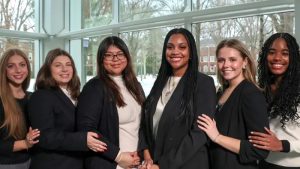
School of Communications students earned an honorable mention in the 2026 PRSSA Bateman Case Study Competition. The student team included (from left) Grace Wizel ’28, Brooke Menzock ’26, Sandy Orozco-Rosaldo ’28, Taylor Radney ’28, Hannah Parker ’26 and Sydney Griffith ’29.
School of Communications students earned an honorable mention in the 2026 PRSSA Bateman Case Study Competition. The student team, pictured below, included (from left) Grace Wizel ’28, Brooke Menzock ’26, Sandy Orozco-Rosaldo ’28, Taylor Radney ’28, Hannah Parker ’26 and Sydney Griffith ’29. This diverse team was mentored by Strategic Communications assistant professor Karen Lindsey.
- Four ÂÒÂ×ÊÓƵ students in the School of Communications were selected, through a competitive national search, to receive a Future Voices fellowship. They are Amanda Marrero’ 28 (Strategic Communications), Gabriela Maldonado Alvarez’28 (Strategic Communications), Laila Cottman’28 (Strategic Communications) and Kemari Logan’ 28 (Strategic Communications and Economic Consulting). Future Voices Collectiveâ„¢ is a nonprofit organization fiscally sponsored by the Social Good Fund, and it provides a two-year paid fellowship to support first-generation college students pursuing careers in public relations and communications. These four ÂÒÂ×ÊÓƵ students will be part of the 23 first-generation undergraduate student cohort from six participating universities. More information is available here: .
- Betsy Schlehuber ’25 wasn’t chasing awards when she began reporting “� This journalism major was trying to fill a gap – to tell a story she felt was missing, one that reflected what it actually feels like to navigate college as an autistic student, in all its challenges, nuance and possibility. And she captured second place in the Feature Writing Competition of the 2025–2026 Hearst Journalism Awards Program, selected from a record 162 entries from 87 schools. Her runner-up finish included a $2,000 award.
- Through a 2025 Pulitzer Center Reporting Fellowship, Latinx junior Lilly Molina’ 27 traveled to Costa Rica in the summer of 2025 to investigate illegal hammerhead shark fishing and the enforcement gaps threatening the endangered species. Lilly Molina also received the Retail/Small Business Journalism Award, in April of 2026, at the .
- ÂÒÂ×ÊÓƵ junior Ethan Wu worked alongside School of Communications faculty members Amanda Sturgill and Randy Piland in Azerbaijan, in fall 2025, as part of a production team documenting one of the world’s most prestigious programming competitions: the – often called the “Olympics of college coding.â€� The annual competition draws more than 60,000 regional competitors from 3,000+ universities.
- Two of 10 accomplished alumni from the past decade selected as part of the 2026 university-wide 10 Under 10 celebration were Journalism alums. According to the ÂÒÂ×ÊÓƵ website, designees “have achieved professional success, continuously work to better their communities and serve as loyal alumni role models.â€� The two Journalism alumni were NBC Legal Affairs Reporter Gary Grumbach ’16 (White male) and New York Times Sports and Features Reporter Emmanuel Morgan ’19 (Black male).
Diverse guest speakers
The School of Communications faculty frequently engages high-level guest speakers, including to present on topics related to inclusive excellence. The following are a few selected examples:
-
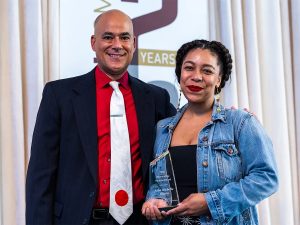
School of Communications Dean Kenn Gaither (left) shares a moment with Asha Michelle Wilson ’13 – one of his former students – during the School of Communications’ 25th anniversary celebration on Oct. 10 in Snow Family Grand Atrium. Wilson, a Hollywood showrunner and writer, was recognized with the school’s 2025 Outstanding Alumna Award. Photo by Aidan Blake ’26.
The School of Communications recognized acclaimed showrunner, writer and producer Asha Michelle Wilson ’13 (Black female) with its 2025 Outstanding Alumna Award during the school’s 25th anniversary celebration held Homecoming Weekend in Snow Family Grand Atrium on Oct.10, 2026. Wilson, co-executive producer of Fox’s animated series “The Great Northâ€� and writer for FX’s “American Horror Storyâ€� and “Archer,â€� has established herself as one of Hollywood’s dynamic creative voices. Her work spans genres and formats – from streaming comedies to psychological thrillers – showcasing her range as both a storyteller and showrunner. She spoke about the power and support of the school’s community during and after her time at ÂÒÂ×ÊÓƵ.
- Investigative reporter Andy Pierrotti (White male, part of the LGBTQ community) of Atlanta News First visited ÂÒÂ×ÊÓƵ on Oct. 22, 2026, to share the human stories behind his five-part Pulitzer Center–supported series “,â€� which explores how vaccine disinformation fueled Samoa’s 2019 measles outbreak. In total, the epidemic infected 5,700 people and claimed 83 lives, most of them children. Pierrotti’s public talk was titled “Tragedy in Paradise: Disinformation and the Samoan Measles Outbreak,â€� and it was delivered in the Jane and Brian Williams Studio in the McEwen Communications Building. His visit was sponsored by the Department of Journalism in partnership with the Pulitzer Center Campus Consortium.
-
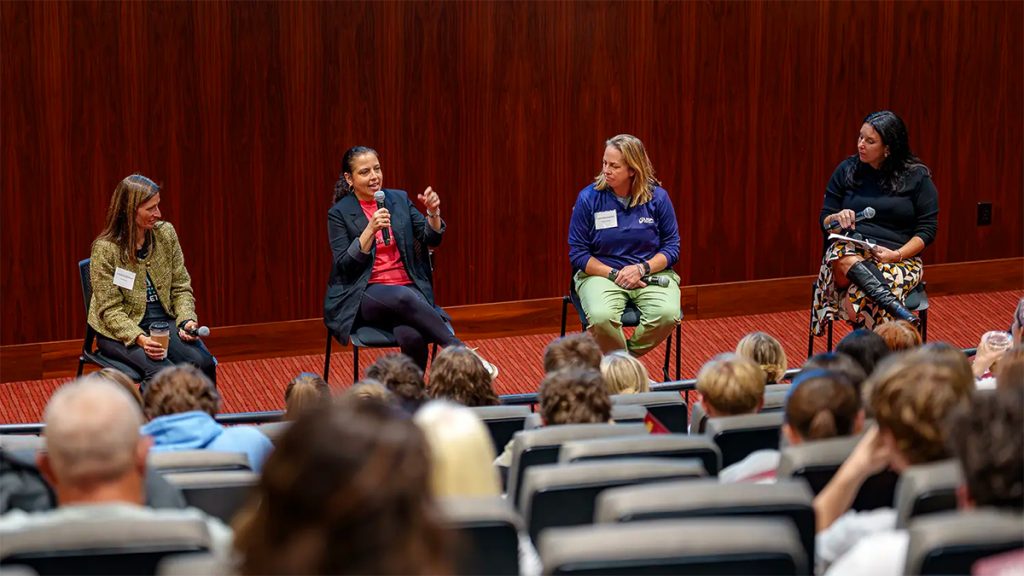
At the 2025 WINS Forum, held Nov. 14, panelists shared insights on the opportunities emerging across women’s sports. This included a panel titled “Monetizing Momentum: The New Era of Women’s Sports,� featuring (from left) Leela Srinivasan of Parity, Sara Toussaint of TMJ, Jenè Baclawski of USA Football, and Jenn Azara of Sports Business Journal. All photos by Ethan Wu ’27.
At the 2025 WINS (Women in Sports) Forum, held Nov.14, 2025 at Turner Theatre, panelists shared insights on the opportunities emerging across women’s sports. This included a panel titled “Monetizing Momentum: The New Era of Women’s Sports,� featuring (from left) Leela Srinivasan of Parity, Sara Toussaint of TMJ, Jenè Baclawski of USA Football, and Jenn Azara of Sports Business Journal. WINS is organized by the Department of Sport Management in the School of Communications.
-
As part of her November 2025 visit, Natalie Allison provided an inside look into political journalism for Elma Sabo’s News Reporting and Writing class.
In November 2025, ÂÒÂ×ÊÓƵ Journalism alumna Natalie Allison ’13, now a White House reporter with The Washington Post assigned to cover President Trump, returned to campus to reflect on her journey from The Pendulum newsroom to the national political stage. In a public conversation held in Turner Theatre, Allison (White woman) discussed the challenges and responsibilities of covering the presidency amid an increasingly polarized political landscape. She also presented at several ÂÒÂ×ÊÓƵ classes that day, as well as with student journalists at ENN.
- As part of separate Spring semester 2026 events, Journalism majors and the general public networked with two nationally recognized journalists: Bill Adair (White male, straight), founder of PolitiFact; and Frank Bruni (LGBTQ community member, White, featured in the picture below), who is a respected New York Times columnist. Both now teach at Duke University. One JOU alum and one current JOU major had roles in both events. Maria Ramirez Uribe ’20 (Latinx woman) is an immigration reporter with PolitiFact and gave a presentation via Zoom to a Journalism in a Free Society class prior to Adair’s speech. Junior Communications Fellow and ENN anchor Charlotte Pfabe introduced Bruni onstage at the Whitley Auditorium.
-
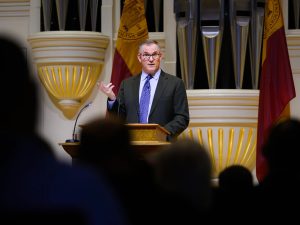
James P. Elder Lecture with Frank Bruni at Whitley Auditorium on April 9, 2026.
Internationally renowned techno-sociologist Dr. Zeynep Tufekci, a Turkish-American author and thought leader (woman of color), spoke in McCrary Theatre on March 12, 2026. New York Times opinion columnist and the Henry G. Bryant Professor of Sociology and Public Affairs at Princeton University, she is known for asking hard questions about artificial intelligence, privacy and surveillance, social movements, mass communication and public health. SOC’s Associate Professor of Journalism Dr. Amanda Sturgill introduced the speaker that night as part of the Baird Lecture.
- Scientist Katharine Hayhoe (White female), an expert in climate change communication, delivered the Earth Week Keynote address “Solving Climate Change Starts with Us (But not the way you think!),� on April 22, 2026, in McKinnon Hall, at the Moseley Center. Hayhoe has been named to several lists including the TIME 100 Most Influential People and Fortune’s 50 World’s Greatest Leaders. Her talk, co-sponsored by the School of Communications, focused on the importance of calling for systemic change to tackle the climate crisis. Hayhoe is the chief scientist for The Nature Conservancy and a Horn Distinguished Professor and endowed professor of public policy and public law at Texas Tech University.
- Katherine Blunt ’15, an ÂÒÂ×ÊÓƵ alumna whose work with the Wall Street Journal placed her as a Pulitzer Prize finalist, delivered the Commencement address on May 20 to graduate students in the Class of 2026. This journalist and author (White female) addressed the graduates for the Master of Arts in Higher Education, Master of Education in Innovation, Master of Science in Accounting, Master of Science in Business Analytics and Master of Business Administration in the Alumni Gym.
Many more guest speakers from the different fields of communications and sport management visited the School of Communications classrooms, student media groups, and venues in AY 2025-2026. A more detailed list can be found in each SOC department’s End-of-Year Report.
Diversity topics in the classroom
Examples of how the school’s faculty included inclusive excellence topics or experiences in the classroom are simply too numerous to be fully captured here. However, we present a list of selected examples at the end of this report, under the section “2025-2026 Inclusive Excellence Faculty Activity Report.� These examples of inclusive excellence-related work include mostly in-classroom content and activities, but also professional activity, as described by faculty members in their Unit I reports (annual reports). See Appendix 1.
Graduating seniors’ perceptions of their knowledge about inclusive excellence competencies
Every year, the School of Communications conducts a survey with graduating seniors that includes questions about these seniors’ perceptions on their knowledge about competencies related to inclusive excellence. For example, the SOC asks seniors whether their classes included discussions about race & ethnicity, the multicultural history of the communication professions, economic class, gender & sexuality, and diverse political points of view. It also asks seniors if they had class projects in which they interacted with classmates of different races and ethnicities, and whether they feel they gained tools to advocate for people of diverse backgrounds. The results for 2025-2026 are the following, for a sample of 215 seniors. Results are presented in cumulative percentages, first by major and then as a total.
Table 1. Cumulative (in percentages): Diversity Engagement by Major (N = 215)
(Marked in yellow are the cumulative percentages of Agree + Strongly Agree)
Note 1: All the statements in this part of the Seniors Survey started with, “During my time as a student in the School of Communications, in my classes we had discussions about…�
| Question | Answer | CDE | CTA | JOU | MEA | STC | Subtotal |
|---|---|---|---|---|---|---|---|
| Q111 (Discussions about race/ethnicity) | Strongly agree | 42.2 | 47.4 | 62.5 | 66.7 | 65 | 57 |
| Agree | 77.8 | 86.8 | 81.2 | 100 | 91.3 | 87.4 | |
| Slightly agree | 91.1 | 100 | 93.8 | 100 | 97.1 | 96.3 | |
| Neither agree nor disagree | 95.6 | 100 | 100 | 100 | 98.1 | 98.1 | |
| Slightly disagree | 97.8 | 100 | 100 | 100 | 100 | 99.5 | |
| Disagree | 100 | 100 | 100 | 100 | 100 | 100 | |
| Strongly disagree | 100 | 100 | 100 | 100 | 100 | 100 | |
| Valid cases | 45 | 38 | 16 | 12 | 103 | 214 | |
| Q112 (Discussions about multicultural history of communication professions) | Strongly agree | 31.1 | 34.2 | 35.3 | 50 | 43.7 | 39.1 |
| Agree | 62.2 | 71.1 | 58.8 | 75 | 74.8 | 70.2 | |
| Slightly agree | 77.8 | 84.2 | 70.6 | 100 | 90.3 | 85.6 | |
| Neither agree nor disagree | 88.9 | 86.8 | 88.2 | 100 | 93.2 | 91.2 | |
| Slightly disagree | 95.6 | 89.5 | 94.1 | 100 | 96.1 | 94.9 | |
| Disagree | 97.8 | 97.4 | 94.1 | 100 | 98.1 | 97.7 | |
| Strongly disagree | 100 | 100 | 100 | 100 | 100 | 100 | |
| Valid cases | 45 | 38 | 17 | 12 | 103 | 215 | |
| Q113 (Discussions about economic class) | Strongly agree | 28.9 | 26.3 | 23.5 | 25 | 36.3 | 31.3 |
| Agree | 46.7 | 60.5 | 52.9 | 25 | 59.8 | 54.7 | |
| Slightly agree | 75.6 | 73.7 | 64.7 | 91.7 | 82.4 | 78.5 | |
| Neither agree nor disagree | 82.2 | 81.6 | 82.4 | 91.7 | 87.3 | 85 | |
| Slightly disagree | 95.6 | 89.5 | 94.1 | 100 | 95.1 | 94.4 | |
| Disagree | 97.8 | 94.7 | 94.1 | 100 | 95.1 | 95.8 | |
| Strongly disagree | 100 | 100 | 100 | 100 | 100 | 100 | |
| Valid cases | 45 | 38 | 17 | 12 | 102 | 214 | |
| Q114 (Discussions about gender and sexuality) | Strongly agree | 28.9 | 47.4 | 41.2 | 50 | 43.7 | 41.4 |
| Agree | 55.6 | 73.7 | 70.6 | 75 | 72.8 | 69.3 | |
| Slightly agree | 82.2 | 92.1 | 82.4 | 91.7 | 90.3 | 88.4 | |
| Neither agree nor disagree | 88.9 | 94.7 | 88.2 | 91.7 | 93.2 | 92.1 | |
| Slightly disagree | 97.8 | 94.7 | 100 | 100 | 96.1 | 96.7 | |
| Disagree | 100 | 97.4 | 100 | 100 | 99 | 99.1 | |
| Strongly disagree | 100 | 100 | 100 | 100 | 100 | 100 | |
| Valid cases | 45 | 38 | 17 | 12 | 103 | 215 | |
| Q115 (Discussions about diverse political points of view) | Strongly agree | 38.6 | 36.8 | 58.8 | 41.7 | 46.6 | 43.9 |
| Agree | 59.1 | 65.8 | 76.5 | 83.3 | 76.7 | 71.5 | |
| Slightly agree | 72.7 | 76.3 | 82.4 | 100 | 84.5 | 81.3 | |
| Neither agree nor disagree | 86.4 | 81.6 | 88.2 | 100 | 90.3 | 88.3 | |
| Slightly disagree | 93.2 | 86.8 | 94.1 | 100 | 93.2 | 92.5 | |
| Disagree | 100 | 97.4 | 94.1 | 100 | 96.1 | 97.2 | |
| Strongly disagree | 100 | 100 | 100 | 100 | 100 | 100 | |
| Valid cases | 44 | 38 | 17 | 12 | 103 | 214 | |
| Q116 (Class projects with people of different races or ethnicities) | Strongly agree | 40 | 45.9 | 47.1 | 41.7 | 44.1 | 43.7 |
| Agree | 57.8 | 64.9 | 64.7 | 58.3 | 68.6 | 64.8 | |
| Slightly agree | 80 | 78.4 | 88.2 | 83.3 | 84.3 | 82.6 | |
| Neither agree nor disagree | 82.2 | 83.8 | 88.2 | 91.7 | 90.2 | 87.3 | |
| Slightly disagree | 93.3 | 97.3 | 94.1 | 100 | 97.1 | 96.2 | |
| Disagree | 97.8 | 100 | 94.1 | 100 | 99 | 98.6 | |
| Strongly disagree | 100 | 100 | 100 | 100 | 100 | 100 | |
| Valid cases | 45 | 37 | 17 | 12 | 102 | 213 | |
| Q117 (Media activities with people of different races/ethnicities) | Strongly agree | 41.9 | 44.7 | 53.3 | 45.5 | 48.5 | 46.6 |
| Agree | 65.1 | 73.7 | 73.3 | 54.5 | 69.1 | 68.6 | |
| Slightly agree | 74.4 | 89.5 | 93.3 | 90.9 | 86.6 | 85.3 | |
| Neither agree nor disagree | 90.7 | 94.7 | 93.3 | 90.9 | 92.8 | 92.6 | |
| Slightly disagree | 93 | 100 | 100 | 100 | 96.9 | 97.1 | |
| Disagree | 97.7 | 100 | 100 | 100 | 99 | 99 | |
| Strongly disagree | 100 | 100 | 100 | 100 | 100 | 100 | |
| Valid cases | 43 | 38 | 15 | 11 | 97 | 204 | |
| Q118 (Gain tools to advocate different background) | Strongly agree | 52.3 | 51.4 | 64.7 | 50 | 63.1 | 58.2 |
| Agree | 77.3 | 83.8 | 88.2 | 83.3 | 84.5 | 83.1 | |
| Slightly agree | 88.6 | 94.6 | 94.1 | 91.7 | 94.2 | 93 | |
| Neither agree nor disagree | 95.5 | 94.6 | 94.1 | 91.7 | 98.1 | 96.2 | |
| Slightly disagree | 95.5 | 94.6 | 94.1 | 100 | 99 | 97.2 | |
| Disagree | 100 | 97.3 | 100 | 100 | 99 | 99.1 | |
| Strongly disagree | 100 | 100 | 100 | 100 | 100 | 100 | |
| Valid cases | 44 | 37 | 17 | 12 | 103 | 213 |
Note: Totals may not always equal exactly 100% due to rounding to one decimal place.
The results for the 2025-2026 Seniors Survey, presented above, are better for every single item than the 2024-2025 results, which were, in turn, better than the results in the survey for 2023-2024. In other words, there is a clear pattern of improvement, as students become, year after year, more informed about issues of diversity, equity, and inclusion and more prepared to engage with diverse groups and to advocate for these values. The item on having discussions about economic class remains the lowest (54.7%), but it is still significantly better than last year’s score (44.7%). All the other items reached percentages that approach or exceed the 70% threshold. If the “slightly agree� percentage was added, then all the results would range between 78.5% and 96.3%.
There was also one general question in the Seniors Survey about the extent to which their communication major contributed to their development of several values and skills, including the value of recognizing the diversity of audiences in this global age. The results for 2025-2026 were highly positive, with this response indicating that 93% of senior students thought that their major contributed very much (74%) or quite a bit (19%) to strengthening their ability to recognize the diversity of audiences in this global age.
| Values (Q3) | Answer | CDE | CTA | JOU | MEA | STC | Subtotal |
|---|---|---|---|---|---|---|---|
| Q35 (Diversity of Audiences) | Very much | 75.6% | 71.1% | 64.7% | 66.7% | 76.7% | 74% |
| Quite a bit | 13.3% | 21.1% | 29.4% | 25% | 18.4% | 19.1% | |
| Some | 11.1% | 5.3% | 5.9% | 0% | 2.9% | 5.1% | |
| Very little | 0% | 2.6% | 0% | 8.3% | 1.9% | 1.9% | |
| Valid cases | 45 | 38 | 17 | 12 | 103 | 215 |
Alumni perceptions of their knowledge about competencies related to inclusive excellence
Every three years, the School of Communications conducts a survey with SOC alumni about different areas, including what they learned about inclusive excellence while they were students in the school. The previous results, from the Alumni Survey conducted in 2023, are included in the SOC Report for 2022-2023, which can be found in the SOC’s Inclusive Excellence website.
The most recent set of results is presented next. Students were surveyed in early 2026, between January 27 and March 1st. The survey received 301 responses from alumni who graduated between 1989 and 2025. Of them, 51% graduated between 2015 and 2025. The largest single cohort graduated in 2023 (n=21). This means that, during their time at ÂÒÂ×ÊÓƵ, only about 20 (6.7 percent) of all these 301 alumni took COM 2000 Inclusive Communications, a course that became a required class in academic year 2022-2023, but only for incoming students and sophomores. The following results must be understood in light of that context.
Regarding cultural-proficiency competencies, alumni respondents evaluated, in 2026, whether the school contributed to their understanding of four inclusive-excellence issues. They are 1. “Work on a diverse team effectively,� 2. “Communicate with audiences with identities different than your own,� 3. “Identify content that might be biased or discriminatory,� and 4. “Advocate for diversity, equity, and inclusion in the industry.�
Three of the four categories exceeded 50%, but none reached 70%, which is still a better result than in 2023, when only two of the four categories exceeded 50% (but, similarly, none reached 70%). In 2026, the cumulative percentages for those who said that the school contributed to their understanding of these issues “to a very high extent� or “to a high extent� were the following:
- Work on a diverse team effectively: 67%
- Communicate with audiences with identities different than your own: 60.3%
- Identify biased or discriminatory content: 54.4%
- Advocate for diversity, equity and inclusion in the industry: 48%.
When asked whether they learned about specific diversity topics during their time at the School of Communications, respondents indicated that they “strongly agree� or “agree� that they learned about ability/disability (35%), race (29%), ethnicity (28.4%), socioeconomic status (27.9%), gender (27.3%), religion (24.7%), and sexual orientation (21.3%).
These results, while at first sight disappointing, are very good news if they are compared to what current SOC seniors say they learned about these same topics during their time at ÂÒÂ×ÊÓƵ, because they demonstrate that the SOC is doing significantly better today than in the past in preparing students to understand more deeply important aspects related to inclusive excellence. As a reminder, for ÂÒÂ×ÊÓƵ seniors who graduated in 2026, all these percentages fell between 54.7% and 87.4, with 93% of them indicating that their major contributed very much (74%) or quite a bit (19%) to strengthening their ability to recognize the diversity of audiences in this global age.
EPortfolios Assessment Transitions into Seniors’ Reflection Assessment
The results for the evaluation of senior exit portfolios conducted in the spring of 2024, which included a reflection on whether students learned about inclusive excellence while at ÂÒÂ×ÊÓƵ and feel prepared to work with and advocate for diverse teams, were included in the SOC Inclusive Excellence Report for 2023-2024, which can be found on the SOC’s Inclusive Excellence website. This assessment was not conducted either in the spring of 2025 or the spring of 2026 because the SOC is changing the format of this assessment tool, which is now called Seniors’ Reflection. It consists of a series of short reflections written by senior students during their capstone courses based on prompts connected to the values, skills, and competencies listed on the ÂÒÂ×ÊÓƵ 11. This new assessment tool will launch in AY 2026-2027.
Student Recruitment and Retention
The School of Communications’ dean and associate dean, as well as different faculty members, collaborate with ÂÒÂ×ÊÓƵ’s ÂÒÂ×ÊÓƵ Office to support its events. As such, school leadership serves as panelists for ÂÒÂ×ÊÓƵ gatherings with prospective students and their parents, and school faculty teach mock classes during Phoenix Fusion Weekend, when underrepresented students are invited to spend the weekend on campus. The SOC dean and associate dean meet monthly with the ÂÒÂ×ÊÓƵ dean and other senior staff members. The School of Communications Fellows Program Director also meets with ÂÒÂ×ÊÓƵ staff regularly.
Several professors from the school participate in Zoom informational ÂÒÂ×ÊÓƵ events at ÂÒÂ×ÊÓƵ such as Viva ÂÒÂ×ÊÓƵ!, Black Advance, API Achieve and PRIDE Raise, and in in-person ÂÒÂ×ÊÓƵ events such as Phoenix Fusion (where accepted students from underrepresented backgrounds spend a weekend on-campus and attend mock classes).
Additionally, the school has a summer Emerging Journalists Program (EJP) for high-school students. Funded by the Scripps Howard Foundation between 2021 and 2024, it is supported now by the university. High school students from around the country apply and are selected to immerse themselves in journalism, either online (through four interactive learning sessions) or in person, for two weeks, in a journalism bootcamp. The online version was attended by 52 students in the summer of 2026. For the more selective on-campus immersive version, 18 carefully selected students come to ÂÒÂ×ÊÓƵ for two weeks. Many of them leave so impressed with the experience that they decide to major in journalism. The program has unintentionally become an admissions tool. The yield for these students is higher than that for the Communications Fellows program, which is above 60%. In its fifth year (summer of 2026), the on-campus immersion program accepted 18 students.
Furthermore, the school’s director of student engagement and special projects, Colin Donohue, provides the ÂÒÂ×ÊÓƵ Office with names of prospective students who have visited the school through personalized tours or interacted with school faculty to identify particularly promising students and ask ÂÒÂ×ÊÓƵ to monitor them. And during Fellows/Scholarships Weekend, school faculty conduct Saturday interviews with prospective students but also interact with them at a social held on Friday night. At those moments, faculty strive to make sure all students —including underrepresented ones— feel seen and welcome at ÂÒÂ×ÊÓƵ.
Beyond scholarships offered at the university level, the SOC Dean’s Office maintains some financial support for students who need additional funding to complete internships and research/creative projects. These funds are not for new students, but they help with the retention of some underrepresented students.
The following are the School of Communications student retention and graduation rates, compared to ÂÒÂ×ÊÓƵ as a whole.
Table 2. School of Communications Retention Rates — Class of 2024 (student cohort that started at ÂÒÂ×ÊÓƵ in fall 2020).
Retention:
| Class of 2024 | Cohort | Sophomore Year | Junior Year | Senior Year |
|---|---|---|---|---|
| COM Students | 307 | 281 (91.5%) | 279 (90.9%) | 274 (89.3%) |
| COM Minority Students | 41 | 36 (87.8%) | 35 (85.4%) | 33 (80.5%) |
| All ÂÒÂ×ÊÓƵ Students | 1,586 | 1,392 (87.8%) | 1,314 (82.8%) | 1,273 (80.3%) |
| All minority students | 283 | 244 (86.2%) | 220 (77.7%) | 211 (74.6%) |
Graduation:
The students with any COM major as last-declared major for the Class of 2024 were 307. Of those, 268 (87.3%) graduated in four years. The minority students with any COM major as last-declared major for the Class of 2024 were 41. Of those, 31 (75.6%) graduated in four years.
The entire ÂÒÂ×ÊÓƵ entering-cohort in fall 2020 was 1,586 students. Of those, 1,225 (77.2%) graduated in four years. The minority students in the entire university entering-cohort for 2020 were 283. Of those, 200 (70.7%) graduated in four years.
Student Demographics
In terms of student body composition, students in the School of Communications have the following demographics (in comparison with the student body at ÂÒÂ×ÊÓƵ):
Table 3. School of Communications’ Student Demographics
Academic year: 2025 – 2026
Total number of ÂÒÂ×ÊÓƵ students: 6339
Total number of COM majors: 830 Male: 207 (25%) Female: 623 (75%)
These numbers do not include Sport Management (SPT) majors. Table 4 (below) presents SPT student demographics.
| Group | Male | Female | % of total in unit/SOC | % (Total in institution) |
|---|---|---|---|---|
| Black/African-American | 15 | 39 | 6.50 | 5.80 |
| White | 160 | 482 | 77.30 | 73.78 |
| American Indian/Alaskan native | 0 | 0 | 0 | 0.13 |
| Asian | 4 | 15 | 2.30 | 2.40 |
| Hispanic/Latino (any race) | 13 | 60 | 8.80 | 8.76 |
| Native Hawaiian/other Pacific Islander | 0 | 0 | 0 | 0.02 |
| Two or more races | 11 | 14 | 3.00 | 3.36 |
| Other race/Unknown | 3 | 9 | 1.40 | 3.63 |
| International students (any race) | 1 | 4 | 0.60 | 2.07 |
For the Department of Sport Management, the student demographics breakdown was the following for 2025-2026. This information is presented separately from Table 7 because this department is accredited through COSMA, a different accrediting body than ACEJMC, which accredits the other majors in the SOC (Strategic Communications, Cinema & Television Arts, Journalism, Communication Design, and Media Analytics).
Table 4: SPT Majors Based on Race/Ethnicity
| Academic Year | American Indian | Asian | Black/African American | Hispanic/Latino | Two or More | Unknown | White | Total |
|---|---|---|---|---|---|---|---|---|
| AY2021-22 | 14 | 8 | 6 | 1 | 166 | 195 | ||
| AY2022-23 | 1 | 16 | 8 | 8 | 3 | 160 | 196 | |
| AY2023-24 | 1 | 3 | 13 | 11 | 9 | 4 | 191 | 232 |
| AY2024-25 | 1 | 4 | 13 | 13 | 11 | 14 | 213 | 269 |
| AY2025-26 | 1 | 6 | 27 | 14 | 4 | 5 | 202 | 259 |
Diverse & Culturally Proficient Faculty
As of the end of spring 2026, 33 percent of the full-time faculty in the School of Communications were from minority communities and 40 percent were female. Eight of the 10 faculty members hired into full-time positions during the past six years have been women (80 percent), and five (50 percent) have added to the faculty’s racial, ethnic and international diversity. Table 5 and Table 6, respectively, present the demographics of full-time faculty and part-time faculty as of the spring of 2026.
Table 5. Full-time Faculty, Spring 2026
Total: 57 (100%). Gender: Male = 31 (54.4%); Female = 23 (40.3%); Non-Binary = 3 (5.25%)
White: 72% (41 of 57)
Non-White: 28% (16 of 57)
| Group | Female | % total faculty | Male | % total faculty | Non-Binary | % |
|---|---|---|---|---|---|---|
| Black/African American | 3 | 5.25% | 3 | 5.25% | — | — |
| Native American | 1 | 1.75% | — | — | — | — |
| Hispanic/Latino (any race) | 1 | 1.75% | 1 | 1.75% | — | — |
| Asian | 3 | 5.25% | 2 | 3.50% | — | — |
| Internat. faculty (any race) | — | — | 2 | 3.50% | — | — |
| White | 15 | 26.3% | 23 | 40.35% | 3 | 5.25% |
Table 6. Part-time/adjunct faculty, Spring 2026
Total: 11. Male: 7; Female: 4.
| Group | Female | % of faculty | Male | % of faculty |
|---|---|---|---|---|
| Black/African American | 1 | 9% | ||
| Native American | 0 | 0% | ||
| Asian | 0 | 0% | ||
| White | 4 | 36% | 6 | 55% |
The School of Communications strives to recruit and support diverse faculty and staff. Faculty search committees are joined by the school’s dean and/or an ÂÒÂ×ÊÓƵ HR representative to discuss and emphasize the importance of attracting candidates with diverse backgrounds.
Faculty search committees include a diverse combination of members in gender, race, ethnicity and seniority level at ÂÒÂ×ÊÓƵ. Intentional measures are taken so the recruiting process is equitable for all candidates (regarding activities during on-campus visits, questions asked during remote and on-campus interviews, etc.). The hiring process also accommodates the particular needs of candidates with disabilities, various religious traditions, specific meal requirements and lactation-space needs, among others. The school conducted one faculty search in 2024-2025 for its Sport Management department. Among all the applicants, the two finalists were from underrepresented groups (a woman and a non-binary applicant). Associate professor Lindsay Pieper started at ÂÒÂ×ÊÓƵ in fall 2025. Additionally, in 2025-2026, the school conducted one faculty search for its Journalism department. Among all the applicants (more than 75 of them), the three finalists were from underrepresented groups (a Black woman, a Latinx woman, and a Black male). Assistant Professor Ghislaine Maxwell was hired, and she will start at ÂÒÂ×ÊÓƵ in fall 2026.
Retention is also an important part of having diverse faculty and staff. At the university level, all new-faculty members across the university form a cohort through a one-year orientation process offered by ÂÒÂ×ÊÓƵ’s CATL (Center for the Advancement of Teaching and Learning). This orientation encompasses monthly sessions centered on engaged pedagogies and techniques, how to navigate a new institution of higher education, and how to write effective annual reports (Unit Is), among other topics. In some of these sessions there are also invited guests from across campus, such as from Human Resources and ÂÒÂ×ÊÓƵ’s FR&D (Faculty Research & Development) committee. These monthly sessions are formative and allow new faculty members to network.
At the School of Communications level, each new faculty member is assigned a senior faculty mentor within the school. These mentors guide new faculty in their transition to the life of the university and through the culture and nuances of the School of Communications. The mentorship happens formally for one year, but in practice, mentoring relationships continue informally for the long-term. Mentor-mentee pairs are encouraged to meet regularly over coffee or lunch, and the school covers all costs.
One measure of success related to these support systems is the fact that the school’s faculty members have been highly successful in attaining tenure and promotion to Associate Professor, promotion to Full Professor, or continuance (in continuing track appointment). For instance, in 2026, the following colleagues received promotion and/or tenure:
- Staci Saltz-Spieker (promotion to associate teaching professor),
- Alex Traugutt (tenure and promotion to associate professor),
- Khirey Walker (tenure and promotion to associate professor),
- Randy Piland (promotion to teaching professor),
- David Bockino (promotion to full professor)
However, two colleagues in the SOC did not receive tenure in 2026.
Faculty Inclusive Excellence
In this 2025-2026 academic year, School of Communications faculty members demonstrated inclusive excellence in numerous ways. For example, several are engaged in efforts at the university level, by serving in roles such as co-Chair of the Hispanic/Latinx Advisory Council, co-advisor of Mi Casa Living and Learning Community, member of PACIE (ÂÒÂ×ÊÓƵ’s Presidential Advisory Council for Inclusive Excellence), member of the Advancing Equity Requirement (AER) Committee, advisor of the International Living and Learning Community, and member of the group ÂÒÂ×ÊÓƵ Partners & Allies. The School of Communications also has an Inclusive Excellence Committee that advises the dean’s office and, among other activities, organizes the annual Spotlight on Inclusive Excellence event. Other important contributions by SOC faculty that are directly connected to inclusive excellence work at ÂÒÂ×ÊÓƵ and in our professional fields beyond campus are listed in Appendix 1 of this document.
SOC faculty are engaged in the professional and local community, including serving on boards of organizations such as the Friends of Alamance County Libraries, the Alamance County YMCA and the Diversity Action Alliance. One faculty member also served in the NCAA (National Collegiate Athletic Association) Diversity, Equity, and Inclusion Committee. Journalism and strategic communications faculty members are part of the National Association of Black Journalists (NABJ) and the National Association of Hispanic Journalists (NAHJ). Another faculty member supported For Alamance, an initiative led by the non-profit Impact Alamance.
SOC’s faculty also participated in multiple training sessions and webinars at ÂÒÂ×ÊÓƵ centered on inclusive excellence through ÂÒÂ×ÊÓƵ’s Advancing Equity Summer Institute, ÂÒÂ×ÊÓƵ’s Center for the Advancement of Teaching and Learning (CATL), ÂÒÂ×ÊÓƵ’s Office of Inclusive Excellence Education and Development, and ÂÒÂ×ÊÓƵ’s Division of Inclusive Excellence, among others. See Appendix 1, at the end of this document, for a selected list. School faculty also attended several external inclusive-excellence trainings. See Appendix 1 for a selected list.
Of note, in AY 2025-2026, the SOC Faculty Inclusive Excellence Award went to Dr. Lorraine Ahearn, assistant professor of Journalism. Her research focuses on the underrepresentation of marginalized communities in the news media. Among her contributions to ÂÒÂ×ÊÓƵ, she chaired, in AY 2024-2025 and 2025-2026, the school’s Inclusive Excellence Committee, coordinating, both years, the logistics for the Spotlight on Inclusive Excellence event in the SOC.
Inclusive Climate
ÂÒÂ×ÊÓƵ periodically participates in externally conducted campus climate surveys for faculty and staff, as well as for students. The most recent surveys were HEDS (Higher Education Data Sharing Consortium, for faculty) in 2023 and the MSL Survey (Multi-Institutional Study of Leadership, for students) in 2021. These surveys have different cycles, so the SOC will have updated results after AY 2026-2027. The aforementioned surveys’ results were included in the school’s Inclusive Excellence Report for 2023-2024, which can be found here. Both sets of results reflect that the faculty and the students in the School of Communications have a positive outlook about the inclusive climate in the school, with averages above the university level.
Following are some ways in which the School of Communications aims to create and maintain a supportive environment for students, faculty, and staff:
- As part of valuing the contributions of all forms of diversity, school faculty seek to recruit underrepresented students during the Communications Fellows/Scholarship Weekend and identify work by underrepresented students to include it in their nominations for the school’s annual Student Awards.
- The school supports all its students, whenever possible, to be recognized for their academic or leadership work at ÂÒÂ×ÊÓƵ and beyond, and this effort includes promoting underrepresented students’ work to achieve recognition beyond ÂÒÂ×ÊÓƵ. For example, in 2025-2026, students in the School of Communications received multiple awards and recognitions (see pages 11-13 of this document for a list of some of the most notable awards they received during this academic year).
- The SOC created the Unity in Communications program in the fall of 2021 to connect students interested in “enhancing diversity and inclusion in the communications and sport management industries.� With support from the dean’s office, this student-run program meets about twice a semester for different events: lectures, discussion tables, social gatherings, arts & crafts sessions, and others. In AY2025-2026, the group was advised by staff member Karla Estrada Pérez, supported by Assistant Dean Vanessa Bravo. Unity`s student leader is Lauren McCowan (President).
Special Programming
This academic year, the School of Communications hosted events such as the following:
- Organized by the school’s Inclusive Excellence Committee, the Spotlight on Inclusive Excellence event, held on March 5, 2026, in the Snow Family Grand Atrium, included a 75-minute program that featured a dynamic speed-rotation format, allowing the nearly 100 students, faculty, staff, and alumni in attendance to engage in meaningful discussions at various table topics every 15 minutes. The roundtable conversations covered a broad range of issues related to inclusivity in communications, journalism, and the media. Subjects included the role of student media in promoting campus diversity and the importance of understanding cultural narratives beyond surface-level storytelling. Other topics explored strategic communications for inclusive excellence initiatives, neuroinclusive communication practices, health literacy, diversity in the age of algorithms, the role of authenticity in brand activism, and the unique experiences of international students navigating cultural differences. Additionally, the students and faculty discussed the politics of play: the roles of race, gender, and power in sport.
Together, topics for this event fulfill several objectives of the school’s DEI plan, including:
– Create programming where students from all majors and identities can come together, get to know each other, and share student experiences
– Infuse and promote DEI as part of engaged/experiential learning.
– Create opportunities for students of diverse backgrounds to be recognized and talk about their cultures.
- The School of Communications hosted its fourth Scripps Howard Emerging Journalists Program (EJP) online and on campus, supporting journalism in diverse and underserved communities and educating high school students who are interested in pursuing careers in journalism. Senior Lecturer Kelly Furnas and Colin Donohue, director of Student Engagement and Special Projects and instructor in Journalism, coordinated the program. This academic year, the school provided 4 virtual sessions and hosted on campus, in the summer of 2025, 18 students from underrepresented socioeconomic, racial and ethnic groups from around the country, to teach them the fundamentals of journalistic research, interviewing, writing, photography, design, videography, editing, and producing, during a 12-day residential immersion program. Students produced a newspaper, aired a broadcast and launched a website during the program. Since 2021, about 60% of the participants of EJP enroll at ÂÒÂ×ÊÓƵ. In the summer of 2026, the SOC accepted a cohort of 18 participants in its immersive, on campus bootcamp.
Student Organizations
Live Oak Communications has had a DEI Plan in place since 2023. The student-run agency also abides by the Diversity Action Alliance pledge, and it works with local and national clients, including through a partnership with the Alamance County Chamber of Commerce. Live Oak students work with at least one client per year that is minority or BIPOC-owned, or whose business directly works toward DEI and community engagement.
Communications
The School of Communications at ÂÒÂ×ÊÓƵ has, on its website, an Inclusive Excellence section where it makes available its annual Inclusive Excellence reports. This webpage also features the school’s current DEI Plan (approved in 2023 for 2023-2028) and the previous one. A list of news stories that showcase some inclusive excellence-focused events and accomplishments is also updated periodically and organized by year.
Appendix 1
2025-2026 Inclusive Excellence Faculty Activity Report
The following are selected examples from 20 different faculty members in the School of Communications about how faculty connect their teaching and professional activity to inclusive excellence. This list is not exhaustive, but it provides a diverse overview. It is followed by a selected list of trainings that faculty in the School of Communications took this academic year, at ÂÒÂ×ÊÓƵ and beyond, to enhance their knowledge on inclusive excellence-related topics. The following abbreviations are used in this list: CDE (Communication Design), CTA (Cinema & Television Arts), JOU (Journalism), MEA (Media Analytics), SPT (Sport Management), and STC (Strategic Communications).
Teaching and Mentoring
- This year, STC students in Strategic Campaigns courses developed work for clients of diverse backgrounds, including Sustainable Alamance (a local program devoted to helping formerly incarcerated individuals locate resources for employment and living), the Family Justice Center (where the students were tasked specifically with increasing applications for camp counselor positions at Camp Hope, FJC’s annual summer camp for children affected by domestic violence), Providence Montessori (a local preschool and K–12 program), and Cakes etc by Cindy (a Black-owned small business in the town of ÂÒÂ×ÊÓƵ). In CTA, elondocs (the documentary club) developed short videos for NGO Family Abuse Services of Alamance County.
Other selected examples, culled from individual faculty members in their Unit Is (annual reports), are the following ones (in some cases, quoted directly from their reports):
Lorraine Ahearn (JOU): “The course JOU 3400 Literary Journalism—CBL, offered as a community-based learning class for the first time, was my most ambitious and successful teaching experience since returning to ÂÒÂ×ÊÓƵ in fall 2022, exceeding quantitative expectations of the ELR (we averaged 60.83 community contact hours per student) and qualitative aspects of high-impact learning. My cohort of a half-dozen journalism students conceptualized, reported and wrote long-form stories in Alamance County on a mix of advanced topics. Among them: the contested 2026 primary reelection campaign of a longtime Republican sheriff; the impact of ICE raids in North Carolina on the local Hispanic community; the paradoxical experience of LGBTQ+ people living in a red-voting county with a visible and vocal Pride movement; an inside view of an overtaxed animal shelter; the meaning of the changing of the guard in Alamance politics; the significance of the Paramount Theatre, now being renovated, to the history and identity of downtown Burlington.â€�
Shanetta Pendleton (STC): She worked as faculty mentor in undergraduate research, mentoring the following three inclusive excellence-focused projects: 1) Student Chaise Hannibal’s (Business Analytics Major, Renaissance Scholar) project titled A Different World: Exploring Student Belonging and Career Preparation for Business Students at an HBCU and a PWI, 2) Hannibal’s second project on The Readiness Divide: Exploring Black Business Students’ Career Preparation at PWIs and HBCUs, and 3) student Savannah Hameed (Journalism/Strat Comm Major, Renaissance Scholar) project, titled From the Streets to the Page: Exploring How Letters to the Editor Mobilized Change in the Civil Rights Movement. Pendleton also mentored Asian student Teresa Cao on a UR project on influencer apologies on social media.
Rebecca Bagley (CDE): “In CDE 3500 Web and Mobile Design, students engage with Design for Good projects that require applying inclusive design thinking to real-world social impact challenges, including designing for small, diverse businesses and critique exercises that explicitly address accessibility, representation, and bias. These activities align with ÂÒÂ×ÊÓƵ’s goals to expand intercultural learning and incorporate pluralistic pedagogies into curricular practice. In CDE 2580 Principles of Communication Design, course content highlights designers from diverse cultural and global backgrounds and requires projects involving culturally responsive research and visual communication. Final projects emphasize ethical representation and respect for cultural traditions, advancing intercultural competence and inclusive pedagogical practices.â€�
Shaina Dabbs (SPT): “In SPT 4270 Event and Venue Management, students completed a community impact presentation analyzing the social and economic influence of sport facilities. Their evaluations incorporated DEI considerations such as youth engagement, accessibility for people with disabilities, LGBTQIA+ inclusion, and cultural programming such as Hispanic Heritage initiatives. This assignment encouraged students to critically examine how sport spaces can serve as vehicles for community inclusion and social impact.�
Israel Balderas (JOU): “In Winter Term, we combined my Media Law and Ethics class with Dr. Matthew Young’s Polarization & Civil Discourse course for a joint session examining Maia Kobabe’s Gender Queer and Abigail Shrier’s Irreversible Damage. These two works have been at the center of national book-banning debates. Using , 50-plus students engaged in what I call ‘brave spaces’ – discussions where productive discomfort becomes a catalyst for growth.�
Ahmed Fadaam (CDE): In his COR 1100 The Global Experience class, assistant professor Fadaam centers on the ancient and modern history of the Middle East, the effect the region has on the rest of the world, the Arab Spring uprisings that happened and are still happening in the region, the rise and downfall of ISIS and its presence in many parts of Iraq and Syria, the international military intervention in these two countries, and the aggravation of the refugee crisis and how it contributes to the rise of Islamophobia.
Michele Lashley (STC): “In my Strategic Writing class, one simulation scenario involved helping our fictional company — COMbucha — expand into the Hispanic/Latine market within the United States. This provided an opportunity to discuss the importance of conducting thorough research to gain an authentic understanding of target audiences rather than relying on stereotypes or assumptions. To support this learning, I created Elena, a custom GPT buyer persona trained to represent a specific demographic within the Hispanic/Latine community. Students could ‘interview’ Elena to learn about her background, cultural values, family traditions, and communication preferences. This AI-powered persona helped students understand the nuance and diversity within any demographic group while practicing culturally sensitive market research. Students found the experience eye-opening and reported gaining deeper appreciation for the work required to communicate authentically across cultures.�
Kelly Furnas (JOU): “I still find a lot of value in the Maynard Institute’s Fault Lines exercise in reporting classes to help students evaluate the inclusion (or exclusion) of demographics in a medium. As with most years, I had students in JOU 1100 News Writing and Reporting use a semester’s worth of The Pendulum for the exercise. It’s a helpful activity that helps contextualize the importance of diversity in sourcing while also acknowledging the potential pitfalls of quotas or tokenism. This year I also had seniors in JOU 4500 Multimedia Journalism and JOU 4970 Investigative Journalism take part in the same exercise, but this time focusing their analysis on their own portfolios. This was an especially powerful exercise, I believe, because it made the numbers seem more personal and actionable to the individual students.�
Barbara Gaither (STC): In her course on Environmental Communications, she dedicated substantial time to environmental justice, weaving this content throughout the semester. “This approach reflects the reality that environmental issues are deeply intertwined with systemic racism and structural inequities. The students’ final project (development of an advocacy campaign) required students to apply course content on advocacy, environmental rhetoric, and environmental justice to an environmental issue they care about.�
Ben Hannam (CDE): “I facilitated intentional conversations with students about race, gender, and socioeconomic status, particularly as these factors intersect with professional practice. These discussions focused on topics such as negotiating job offers, cost of living, and pay inequities. I also engaged students in thoughtful dialogue around major news events related to politics and race, encouraging critical reflection and respectful discussion of complex social issues. In these conversations, I emphasized the importance of empathy, evidence-based reasoning, and active listening, helping students develop the skills needed to engage productively across differing perspectives. By situating these topics within real-world professional and societal contexts, I encouraged students to consider how identity, access, and power shape career opportunities and creative decision-making. These discussions reinforced classroom inclusivity and respect while preparing students to navigate diverse professional environments.�
Ray Johnson (CTA): In the core capstone seminar COR 3840 JFK Assassination in Film, he expanded its contents to include comparative sections on the assassinations of Dr. Martin Luther King Jr. and Malcolm X, featuring films by African American directors such as Spike Lee, John Singleton, Ava DuVernay, and Ryan Coogler. “These additions prompted meaningful discussions of civil rights, race, and American political culture, while situating the Kennedy assassination within the broader social upheavals of the 1960s.�
Derek Lackaff (CDE): “Valuing diversity—professionally and otherwise—is a cornerstone of effective communications teaching and learning. In my teaching, this was reflected most extensively and directly in the language and visual design course CDE 3600 Contemporary Practices. Students learned about a wide range of themes related to culture, power, and intercultural communication. A major focus was on indigenous cultures and minoritized languages such as Yesa:sahį and Cherokee in North Carolina. The class learned how to work respectfully with culture and language as designers and avoid visual and other stereotypes.�
Julie Lellis (STC): In COM 3370 Health Communications, she continued to emphasize topics related to diversity, especially as it relates to healthcare and health literacy. Student project topics this year included vaccine misinformation, promotion of GLP-1 medications for weight loss, and social media’s effects on mental health. “In HMC 4970 Senior Seminar in Health Communications, my students worked with the Gender and LGBTQIA center on campus to consider how to address issues around sexual assault on campus. Students worked with significant amounts of primary and secondary data to develop a campaign to engage college men in sexual violence prevention.�
J.P. Lavoie (CDE): “Acknowledging diverse learning styles, paces, and abilities, I use a multi-modal approach to instruction to facilitate inclusive teaching. Students can engage with course content through live and recorded lectures, video tutorials, written resources, and full access to presentation materials. All video resources (including live streaming) have transcriptions. I am a firm believer in setting my courses up to take into account those students with accommodations. Because I record every class and that recording comes with transcriptions, students do not need note takers for my class. For tests, I use a full class period and strict instructions about noise levels so that students who have testing accommodations do not feel like they must go someplace else to take the test.�
Lindsay Pieper (SPT): As a new faculty member at ÂÒÂ×ÊÓƵ, her Unit I reflects on inclusive excellence as follows: “I fostered respect for diversity by embedding it into my course objectives, content, and classroom practices. For example, in SPT 2120, students examined historic and contemporary barriers in sport, including issues of gender and racial inequity, to promote their awareness of different experiences and ongoing structural issues. We also discussed local and national policies about the inclusion or exclusion of transgender athletes. In SPT 2320, students learned how biases and stereotypes influence research outcomes. Beyond course content, I created inclusive learning environments by using different discussion formats to ensure all voices are heard.â€�
Karen Lindsey (STC): “STC 3710 Strategic Communications and Social Change (31 students) was the most fulfilling course I taught in 2025. I created this 4-credit elective course and applied for AER (Advancing Equity Requirement) approval because of my observations when teaching COM 2000 and identifying the need to deepen understanding and engagement with students on sensitive topics involving race, social change, and the important role of strategic communications beyond a half semester…� [As part of this course], “students were required to create a final project in the communication format of their choosing (podcast, op-ed, website, social media, short film, etc.) to frame and tell stories of an intersectional identity group. To help students understand how to use storytelling from a voice-centered perspective, I invited documentary filmmaker and CEO of Arise Group, Sean Eldridge, to speak to the class about how to engage in effective storytelling related to marginalized communities.�
Randy Piland (CDE): He layered in DEI-driven learning, particularly through the “Let’s Educate Each Other� project tied to the Nieman Foundation’s Racial Reckoning report. “This wasn’t checkbox diversity – it was students analyzing, reporting, and presenting on race, trust, representation, and power inside journalism.�
Professional Activity and Service
When reading each faculty member’s Unit I (annual) report, it is clear there is a sustained, intentional, and scaffolded process where faculty members are learning more about diversity, equity, and inclusion to apply this knowledge to their courses and their work outside of the classroom. School of Communications faculty are also reading books and articles, attending training sessions on campus and beyond, and following processes of self-reflection to become more aware and knowledgeable about inclusive excellence. These are some examples of what they did this year:
Lee Bush (STC): “I presented at the biennial Integrated Marketing Communications conference in Wilmington. My presentation was titled, “Diversifying the narrative of the outdoors: Assessing student understanding of representation, authenticity, and nuance through an inclusive storytelling assignment.� During the presentation, I discussed the importance of inclusive storytelling in IMC, outlined the inclusive storytelling assignment I use in my Inclusive Communications course, provided examples of student stories, and summarized results of the “student assessment of learning goals� survey given to students after assignment completion (approved by the IRB). I also mentored Donelle Leak in her successful completion of her Honors thesis, titled “Exploring the lack of diverse representation in influencer marketing, its impact on the lived experiences of young Black women, and considerations for developing a more inclusive model.� She completed her thesis in the spring and successfully defended it.�
Derek Lackaff (CDE): He continued professional activity to support ÂÒÂ×ÊÓƵ’s collaboration with the Occaneechis. “In the spring, I developed and published keyboard layouts for MacOS and Windows. This allows Yesa:sahį speakers and learners, for the first time, to easily type their language. I have continued revising these projects based on user feedback (mostly, students in Dr. Corey Roberts’ language classes) and am now developing keyboards for mobile use on iOS and Android devices.â€�
Shanetta Pendleton (STC): Both her publication and AEJMC award-winning presentation in this academic year focused on topics about inclusive excellence. These are the references:
- Pendleton, S. M. (2025). Friend or Faux: Testing the Perceived Authenticity of Corporate Socio-Political Activism Messages on Instagram Through the Lens of Black Lives Matter. Public Relations Review.
- Pendleton, S. M. & Gibson, R. (2025, August). Identity-Based Differences in Journalism and Communication Students’ Sense of Belonging and Community Amid Attacks on University DEI Initiatives. Association for Education in Journalism and Mass Communication (Scholastic Journalism Division Top Paper Session). Top Paper Award- 2nd Place.
Vic Costello (CTA): He coordinated the program and presented at the 12th annual Vision Africa Media Institute, in Umuahia, Nigeria, to educate about 300 future media practitioners on how to navigate modern media landscapes.
Dan Haygood (STC): “While trying not to be hyperbolic, perhaps the highlight of my entire academic career occurred at the AEJMC Southeast Colloquium held in the Hussman School of Journalism & Media at the University of North Carolina at Chapel Hill. It was the Southeast Colloquium’s 50th anniversary. Three of my students had their papers accepted, and thus they presented at the conference. All three young women did a terrific job. I was so proud to have been a part of their research journey.
- Mackenzie J. Smith – “Model Queerness: Intersectionality within the Representation of Mainstream Queer Film Post-Obergefell v. Hodgesâ€�
- Callie Reing– “TikTok Narratives: An Analysis of Harris’s and Trump’s TikTok Strategies Following the Presidential Debate�
- Betsy Schlehuber – “A Special Interest in Spontaneity? Newsroom Experiences of Journalists with Autism Spectrum Disorder and How Employers Can Accommodate�
Vanessa Bravo (STC): In the fall of 2025, she launched a Latinx/Hispanic LLC (Living and Learning Community) at ÂÒÂ×ÊÓƵ, called Mi Casa, which she is co-leading for its first two years with Assistant Dean of Students Sylvia Muñoz. So far, they enlisted 30 new members, created the LLC syllabus, and hosted monthly activities with its students in the fall semester. This is an LLC open to any student interested in learning more about Latino cultures. Bravo also co-advised, along with staff member Karla Estrada Pérez, the student organization Unity in Communications, which had two meetings in the fall, grew to 20 members, and established an executive board. And, in professional activity, among other things, Bravo was a keynote speaker at two events in Mexico (one invited speaking engagement in Mexico City, on Zoom, and one in Cancún, in person, both organized by the Mexican Association of International Studies –AMEI) to talk about the role of diaspora communities in public diplomacy. At AEJMC, her co-authored paper received a Top-2 Award for the category on Papers Focused on Latin America, from AEJMC’s International Communication Division (ICD). It focused on the results of a survey of Costa Rican journalists that showcases the deterioration of the freedom of the press in this Central American country since 2020.
Sydney Nicolla (STC): In her Unit I, she summarized her connections to inclusive excellence work in this way: “I furthered my own understanding of diversity, equity and inclusion this year by participating in the Advancing Equity Summer Institute. I furthered my understanding of gender equity on campus through conversations and trainings with SAGIC and Title IX. I continue to focus my research on gender and health equity. I am hopeful to make a public impact and promote a safer world experience for everyone through my research and work on campus. I will continue to be an advocate for gender-based violence prevention at ÂÒÂ×ÊÓƵ.â€�
Hal Vincent (STC): He was selected for AEJMC’s Equity and Diversity Awards Committee, as its Council on Divisions representative. As part of this task, he reviewed application materials from universities across the US to recognize excellence in DEI initiatives.
Inclusive Excellence-Related Trainings:
School of Communications faculty participated in inclusive-excellence trainings at multiple sessions during the year. The following is a selected list of events/organizations that our faculty attended to continue their process of learning about inclusive excellence:
At ÂÒÂ×ÊÓƵ:
- CATL (Center for the Advancement of Teaching and Learning)’s Summer Faculty Institute on Supporting Neurodivergent Students
- ÂÒÂ×ÊÓƵ’s Advancing Equity Summer Institute (3 days)
- Global Education Center’s session Managing Bias on Short-Term Study Away Programs
- Winter Term Study Abroad Title IX Training
- CREDE’s Big 8 Workshop
- Data Justice and AER Luncheon Series
- Inclusive Community Conversation “Navigating in the Current Climate – Safety, Speech, and Solidarityâ€�
- ÂÒÂ×ÊÓƵ’s sessions “Psychological safety in inclusive workplaces,â€� “Impact of belonging and diversity,â€� and “Practicing courageous conversationsâ€�
Beyond ÂÒÂ×ÊÓƵ:
- Sessions of AEJMC\s Minorities & Communication (MAC) Division
- Session “Effective strategies for teaching DEI amidst pushback from outside forces,� at BEA (Broadcast Education Association)’s annual conference
- Hypothesis’ session “Social Annotation to Foster Equity and Belonging�
- North Carolina American Council of Education (ACE)’s Women’s Conference
In summary, this Inclusive Excellence Report for AY 2025-2026 showcases the ways in which the School of Communications (SOC) at ÂÒÂ×ÊÓƵ educates culturally proficient communicators to be prepared for a global society, in alignment with ACEJMC’s Standard 4: Advancing a Culturally Proficient Workforce.