Ƶ

Innovative Teaching and Learning in an Era of Opportunity

Building upon decades of curricular innovation and national leadership in experiential learning, we will:

Theme Progress:
43%

Engaged Learning and Mentoring

BOLDLY ELON will magnify the transformative power of student- and learning-centered relationships. With Ƶ’s characteristic drive for continual improvement, we will deepen engaged learning, providing every student with access to high-impact experiences. Through a groundbreaking mentoring model, students will learn to build developmental networks that include peers, staff and faculty, as well as others beyond the university.

This lifelong constellation of mentors will emerge as a hallmark of an Ƶ education, engaging all students in developing essential skills and fluencies – writing, speaking, creative problem solving, collaboration, intercultural learning, data competency, media literacy, ethics and personal and professional agility.

Objectives and Progress

Last updated: August 2026

Objectives

  • Create a four-year mentoring model, teaching every student to build a network of mentors, including peers, faculty, staff and others beyond the university.
  • Provide financial resources to ensure all students have access to internships.
  • Achieve 100 percent participation in course-embedded undergraduate research and engage one-third of undergraduates in one-on-one, deeply mentored undergraduate research.
  • Deepen our #1-ranked study abroad program, making it accessible to all students and increasing students’ acquisition of second languages.
  • Prepare every student to participate in community and civic engagement, gaining essential skills and an understanding of their civic responsibilities.
  • Promote leadership development through peer mentoring, student employment and student organizations.
  • Provide all students the opportunity to work closely with faculty or staff members to design and complete deep and culminating signature projects.
  • Endow the Center for Engaged Learning as it becomes the leading international center for research on engaged learning.

Key:

  • Developing
  • Progressing
  • Complete

Progress Report

  • The four-year mentoring model continues to advance, with the first-year experience fully implemented and students building developmental networks that extend across the undergraduate years.
  • Ƶ’s study abroad program remains the national leader. Five new sections were added to Winter Term study abroad opportunities for 2025. To expand the number of programs available in the future, the Global Education Curriculum Committee (GECC) is streamlining the faculty program proposal process.
  • New study abroad programs are serving students in majors that are historically underrepresented in study abroad. These include a nursing program in Cuba launched in 2025 Winter Term and a Business Fellows semester track program in Sydney, Australia, and a Singapore internship program.
  • Ƶ launched a Study Abroad Fair during International Education Week, which included providers, partner universities, and on-campus offices that work with study abroad students.
  • We continue to progress on the Global Education Center’s 52-point Diversity, Equity, and Inclusion plan. The GEC is creating programs to serve students in majors and with identities that are historically underrepresented in study abroad. For example, a program for nursing students is being launched in Cuba in Winter Term 2025, a new Business Fellows semester track will be offered in Sydney, Australia, and a replacement center for Shanghai is planned to be launched for Fall 2025.
  • Work continues to expand participation in course-embedded undergraduate research and to remove financial barriers to internships — both priorities for the second half of the plan.

STEM, Engineering, Nursing and Data Competency

In response to the global demand for more engineers and STEM-related skills, BOLDLY ELON will advance a distinctive and cross-disciplinary STEM program. Graduates of these programs, grounded in the liberal arts and experiential learning, will be sought after as problem-solvers focused on the common good.

Objectives and Progress

Last updated: August 2026

Objectives

  • Develop a nationally known school of engineering distinguished by engaged learning and a strong foundation in the arts and sciences.
  • Launch nursing programs and related healthcare certificates with leadership from the School of Health Sciences and a program at the intersection of health communications and health administration led by the communications and business schools.
  • Develop curricula, short courses and certificate programs across the curriculum in all colleges and schools to ensure all students are prepared to access, analyze and manipulate complex data.
  • Build engineering and physics facilities to anchor a new STEM and innovation quad and promote collaboration and discovery across disciplines, design thinking and entrepreneurship.
  • Renovate McMichael Science Center and open a university-wide STEM Center to support students across all majors and expand industry connections.

Key:

  • Developing
  • Progressing
  • Complete

Progress Report

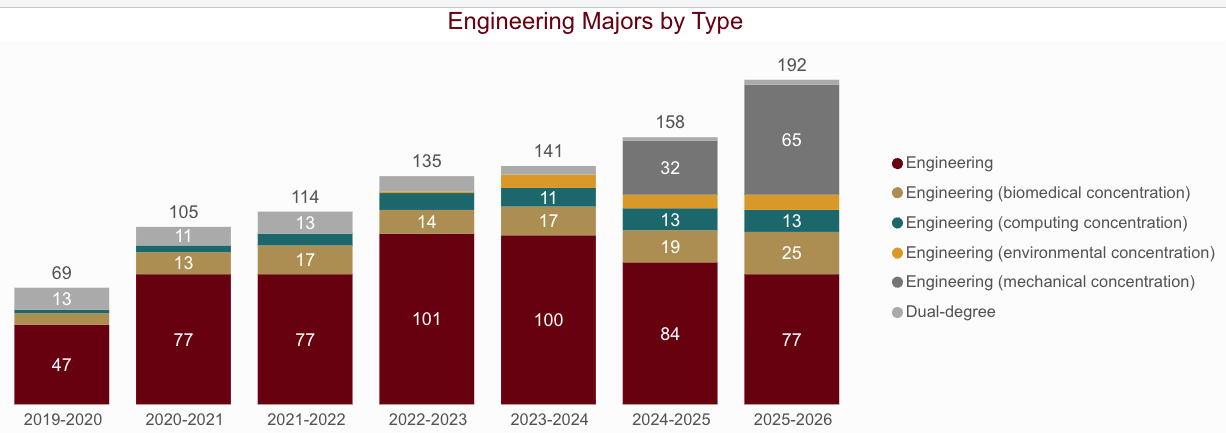
  • The School of Engineering and Computing opens in fall 2026 under inaugural Dean John Walz, president emeritus of the Milwaukee School of Engineering. The school launches with 20 full-time faculty and more than 300 undergraduate students, uniting engineering with computer science, cybersecurity and game design.
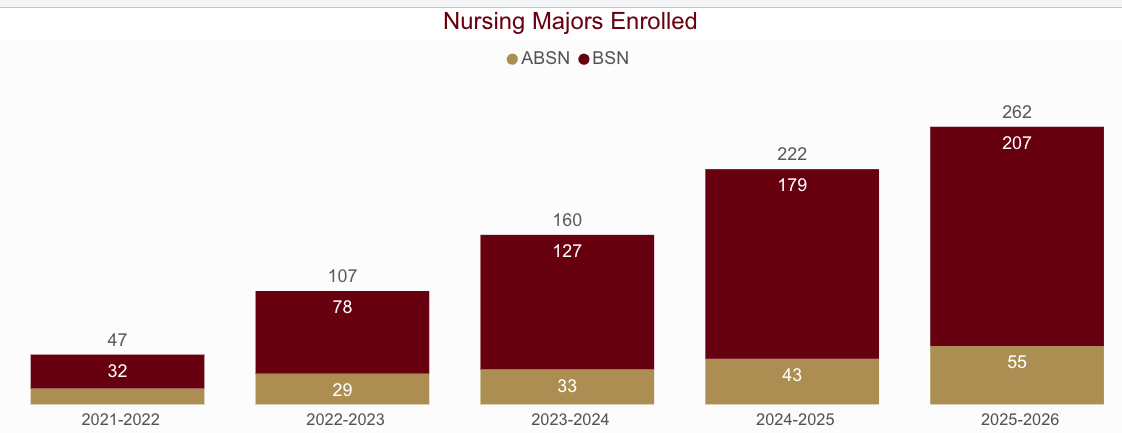
  • Nursing programs have earned initial accreditation from the National League for Nursing Commission for Nursing Education Accreditation, and enrollment continues to grow.
  • The Innovation Quad is fully operational. Innovation Hall and Founders Hall provide 65,000 square feet of laboratory and collaborative space anchoring STEM education.
  • The McMichael Science Center renovation is complete, expanding capacity for environmental science, biology and chemistry.
  • The Data Nexus is active, advancing data competency across the curriculum alongside expanding programs in artificial intelligence

Metrics

Bar chart showing the number of nursing majors enrolled

This chart shows 207 BSN and 55 ABSN majors in 2025-2026.

Bar chart showing engineering majors by type

The graph shows the number of engineering majors by type at Ƶ from 2019-2020 to 2025-2026. Overall, the number of engineering majors has increased over the past seven years from 69 to 192.

Innovative Teaching and Learning Across the Curriculum and for a Lifetime

Ƶ’s rich intellectual community has been propelled by the strategic choice to place excellence in arts and sciences — central to the development of freedom of thought and liberty of conscience – at the core of the undergraduate curriculum and fully integrate it with outstanding professional schools and graduate education. Boldly Ƶ will deepen the arts and sciences, Core Curriculum and work across disciplines, ensuring that graduates are creative, culturally agile, ethically grounded and well-prepared to address questions of societal importance.

Objectives and Progress

Last updated: August 2026

Objectives

  • Deepen students’ engagement in the arts and sciences through cross-disciplinary programs, engagement with challenges facing our world, individual degree pathways and flexible study options.
  • Advance the College of Arts and Sciences, Martha and Spencer Love School of Business, Dr. Jo Watts Williams School of Education and the Schools of Education, Law, Communications and Health Sciences, and grow graduate and professional education for alumni, adult and professional learners – in analytics, health sciences, education, arts, entrepreneurship and developing fields.
  • Develop 3+1 or 3+2 programs to provide interconnected undergraduate and graduate degrees.
  • Further develop Ƶ’s leadership in public policy research, expanding the scope of the Ƶ Poll as a national survey and reconceiving the Imagining the Internet Center as an interdisciplinary effort focused on the impact and evolution of digital life.
  • Achieve national recognition for the School of Law, a leading innovator in legal education, for its highly experiential and distinctive approach to preparing students for the legal profession.
  • Achieve top-40 rankings for the Love School of Business graduate and undergraduate programs.
  • Construct spaces for Ƶ’s nationally recognized theatre, music, dance, design and music theatre programs.

Key:

  • Developing
  • Progressing
  • Complete

Progress Report

  • Ƶ Law’s Class of 2025 set the school record for first-time bar passage at 90.9 percent across North Carolina and 11 other states, including a record 91.96 percent on the North Carolina exam. The school has been named a Princeton Review “Best Law School” for ten consecutive years.
  • Ƶ Law has established a part-time Flex Program in Charlotte, N.C., and the American Bar Association has given approval for Ƶ Law to open a full-time J.D. program on the Queens University campus in fall 2027. The charter cohort will graduate in December 2029, following Ƶ Law’s existing 2.5-year, seven-trimester academic calendar in Greensboro. The Ƶ Law Flex Program will also begin holding its part-time evening classes on the Queens campus in Fall 2027.
  • ճImagining the Digital Future Center has received international recognition for its ongoing release of high quality research reports on the evolution of digital technologies, especially artificial intelligence. Reports over the last two years have focused on Human Resilience for the Age of AI, the impact of AI on core human capabilities, the increasingly human-like way people are engaging with AI and the rise of the age of AI companionship.
  • The Imagining the Digital Future Center coordinated development of an international position statement on higher education and artificial intelligence. The statement has been endorsed by more than 140 higher education organizations, administrators, researchers and faculty members from 47 countries. Building on that foundation, the Center has produced three editions of the  in partnership with the American Association of Colleges and Universities (AAC&U). The guide is distributed as a free learning resource and has been adopted by more than 35,000 educators and students at more than 4,000 colleges, universities and schools in 170+ countries.
  • The Ƶ Poll continues to produce high quality public opinion polls in North Carolina and nationally. Two recent major initiatives have included a national survey on the future of college athletics conducted in partnership with the Knight Commission on Intercollegiate Athletics, and a special national conducted to coincide with the 2026 250th anniversary of the Declaration of Independence.
  • The Love School of Business has held its Top 40 undergraduate ranking for four consecutive years.
  • Accelerated 3+2 pathways have been established for undergraduates to move into Ƶ’s graduate Physician’s Assistant and Physical Therapy programs. Undergraduate students are also participating in the accelerated 3 +2 ½ pathway into the Ƶ Law School.
  • Ongoing collaborations across academic units continue in creating interdisciplinary minors and programs, including:
    • Data analytics interdisciplinary major
    • Neuroscience co-major (with biochemistry, biology, chemistry, exercise science or psychology)
    • FinTech major (finance and technology)
    • Cybersecurity minor
    • Innovation in education master’s program (M.Ed.)
    • Concentration in Environmental Engineering
    • Engineering Design minor
    • Health communications minor
    • Food and Culture minor
    • Expressive Arts minor
    • Museum Studies & Public History minor
    • Islamic studies minor
    • Sustainable enterprises minor