


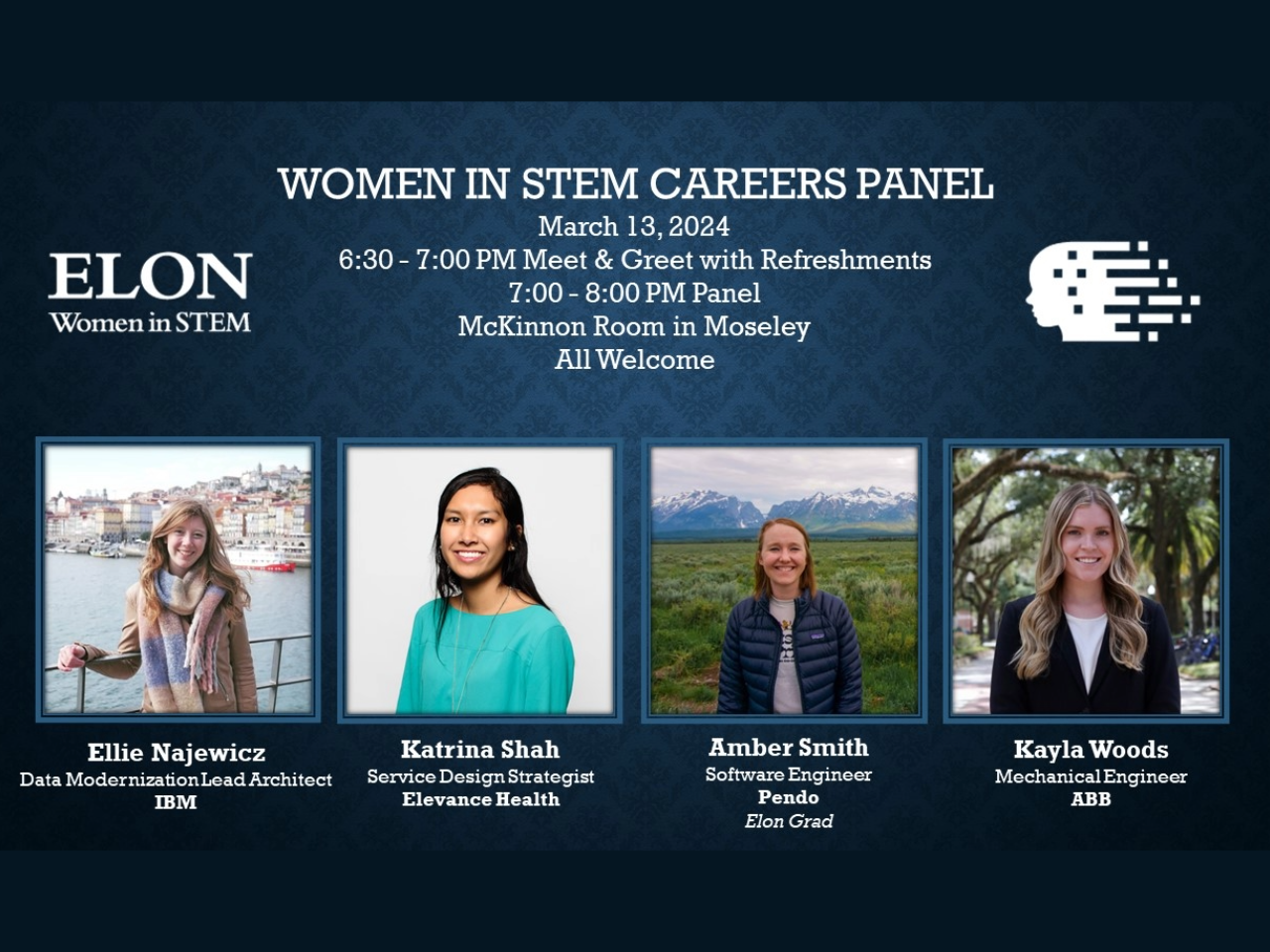
Four female professionals, including ÂÒÂ×ÊÓƵ alumna Amber Smith ’14, will share advice and experience with ÂÒÂ×ÊÓƵ students from 6:30- 8 p.m. Wed., March 13, in McKinnon Hall.
Since graduating from ÂÒÂ×ÊÓƵ with a degree in computer science, Amber Smith ’14 has found her niche in big data.
As a staff software engineer and tech lead at Pendo in Raleigh, North Carolina — a software company that develops tools to capture user behavior and feedback on apps to drive improvements in user experiences — Smith works with a team of specialists to collect “all the data that powers our analytics and features.�

“We’re ingesting billions of events a day,� Smith said. “There are hard problems to solve, and it involves a lot of brainstorming and collaboration. Seeing those problems get solved and implemented start-to-finish is really rewarding, and that’s the reason I wanted to work at Pendo.�
Another thing Smith finds rewarding in her work: Supporting other women in STEM.
She will be among a slate of speakers at the ÂÒÂ×ÊÓƵ Women in STEM Careers Panel, 6:30-8 p.m. Wednesday, March 13, in McKinnon Hall. Though geared toward female and female-identifying students, all students are welcome to attend. The panel will also include Ellie Najewicz, a data modernization lead architect at IBM; Katrina Shah, service design strategist at Elevance Health; and Kayla Woods, a mechanical engineering at ABB.
Women are underrepresented in STEM. ÂÒÂ×ÊÓƵ Women in STEM is a pilot professional development program to foster support for female and female-identifying students pursuing STEM careers. It is a collaboration between , the Student Professional Development Center and ÂÒÂ×ÊÓƵ College, the College of Arts and Sciences. The program is coordinated by Terri Mitchell, a former IBM executive, founder of Accelerate Success and a co-founder of . Mitchell is also a member of ÂÒÂ×ÊÓƵ’s Engineering Advisory Board. Mitchell was called to act after noticing a decline in the number of women in the tech industry.
The March 13 panel event is designed to elevate confidence among ÂÒÂ×ÊÓƵ students planning careers in science, technology, engineering and math, and to build a professional network of support for female and female-identifying students as they enter the field.
Those are areas Smith is passionate about, and she wants to support ÂÒÂ×ÊÓƵ students as they prepare for potential challenges like imposter syndrome as they enter the workforce.
“When I was at ÂÒÂ×ÊÓƵ, I never had to think twice about it: So many of my professors were women, there were many other women in my classes, and I felt supported from day one,â€� Smith said. “In the workforce, there are times you are the only woman in the room, and that was a reality shock. Over the years, I’ve learned how important it is to have that support system. Even if they aren’t on your team, it is helpful to develop a network of women you can talk to when you need support.â€�