


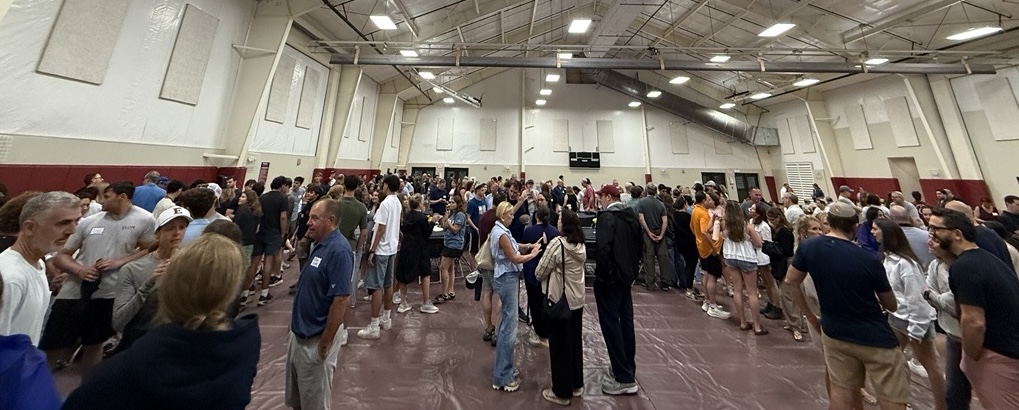
Jewish Life at ÂÒÂ×ÊÓƵ welcomed the incoming class of 2030 with a shabbat dinner and Jewish activity fair. Rabbi Maor Greene delivered a teaching on how the Jewish community at ÂÒÂ×ÊÓƵ supports one another. Representatives from Hillel, Chabad, AEPi, AEPhi and Hebrew Club also attended the event.
This teaching was given during Orientation at ÂÒÂ×ÊÓƵ’s Move-in Shabbat on Aug. 21, 2026.
Welcome to ÂÒÂ×ÊÓƵ! Welcome first years, welcome back returning students, and welcome families. We are so very glad that you have chosen to be here with us.
This week’s Torah portion (parshah) is called . Ki Teitzei means “when you go out�. In the parshah, this going out refers to war and is immediately followed by laws governing the taking of captives. The parshah then provides an extensive collection of commandments.
I’m going to go out on a limb and say that while I imagine that moving into ÂÒÂ×ÊÓƵ may have been a rough or challenging experience for many of you, it probably didn’t feel like going to war. At the very least, I hope it did not! However, I imagine that going out from the homes and families you have grown up in has also involved taking care of an extensive list of seemingly unconnected details, just like the parshah.
In looking over these detailed commandments, one struck me as essential to thriving here at ÂÒÂ×ÊÓƵ. says “If you see your brother’s [or your fellow’s] donkey or ox fallen on the road, do not ignore it; you must raise it together.â€�
At first glance, this verse may not appear to be relevant to our lives. I am unaware of any donkeys or oxen present on ÂÒÂ×ÊÓƵ’s campus, although if senior administrators know differently, please let me know! [Correction: apparently have been an issue!] However, if you bear with me, I will show you why this verse still matters for us here today.
The Talmud () – an ancient collection of commentary on rabbinic law considered authoritative for traditional observance even today – connects this passage with a similar passage from : “When you see a donkey of your enemy lying under its burden and would refrain from raising it, you must nevertheless help raise it.�
According to traditional rabbinic interpretation (), the verse from Exodus commands us to remove undue burdens from animals, even animals belonging to people who hate us. This command shows us that we should alleviate animal suffering whenever possible.
However, the verse from this week’s parsha in Deuteronomy is understood to command us to put a load back onto an animal if its load has fallen off. This verse teaches us that we should not just care for the animal, but also for the owner of the animal, honoring their intentions to build a secure life for themselves. The verse also clarifies that we are meant to put the load back onto the animal with the owner. We are meant to care for the economic success and flourishing of our fellows with our fellows.
So why does this matter? These laws in these verses matter in three ways.
First, many of us live our lives carrying heavy emotional burdens. We are not donkeys or oxen, but college life can sometimes be a lot to bear. If the Torah asks us to alleviate animal suffering, how much more so would it want us to assist each other in relieving our own suffering? We at Jewish Life (Betsy, Boaz, Jay, Sarah, Tal, and myself) want you to know that we are here for you and will be here for you whenever you need us.
Second, college is also a time of growth and opportunity. There are some burdens (such as the responsibilities and privileges of adulthood) you will want to take on! Classes, internships, study abroad, leadership experiences, Greek life, clubs – these are aspects of college life that I know many of you are already excited about! We are also here to help you grow in the ways you want to grow and support your flourishing!
Finally, you may have heard the phrase – all of the Jewish people are responsible for one another. I believe that forming relationships – with mentors and with each other – is the most important part of the college experience. I know that it can sometimes take time to make friends at college and to find your place. It is totally normal to feel anxious about making friends. If you do feel this way, know you’re not alone!
As you and your families adjust your being in college, I hope all of you gathered here today know that you will always have a home with Jewish Life at ÂÒÂ×ÊÓƵ. We’re here to help you let go of or manage the burdens you don’t want, take on the burdens you do want, and help you form the relationships with one another that will sustain you through college and beyond. We are so happy that you have chosen to make your home with us. Kol yisrael arevim zeh bazeh. Let us all take care of one another. Shabbat shalom.
-
Betsy Polk
Senior Director of Jewish Life
-
Boaz Avraham-Katz
Jewish Educator and Instructor
-
Jay Rimmer
Assistant Director of Operations for Jewish Life
-
Sarah LaPedis
Assistant Director of Jewish Life for Communications and Development
-
Tal Bendersky
Israel Fellow
-
Maor Greene
Associate Chaplain for Jewish Life