


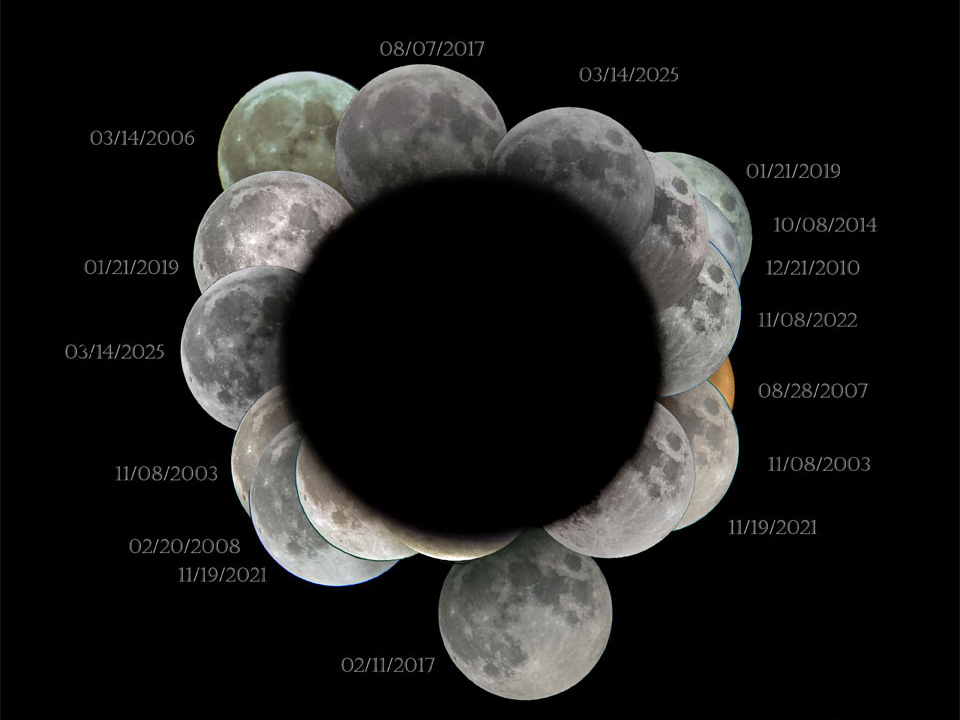
Tim Martin in the Department of Physics and Astronomy photo was selected for NASA’s Picture of the Day on August. 25.
For more than two decades, Tim Martin, instructor in physics, has documented lunar eclipses from locations around the world. His patience and persistence earned national recognition when his photo was selected as the National Aeronautics and Space Administration’s (NASA) Astronomy Picture of the Day on Aug. 25, 2026.
Martin’s 22-year astrophotography project captures the shape of Earth’s shadow through a series of lunar eclipses. The collage is the culmination of a long-term astrophotography project that began with Martin’s first digital photograph of a lunar eclipse in 2003. By combining multiple images across eclipses, he completed the collage in March 2025 that shows the complete shadow of the Earth.
The project was inspired by the observation and documentation of lunar eclipses by the ancient Greeks who concluded the reason why occasional full moons look different was due to the Moon passing into the shadow of the Earth. Martin’s interest in astrophotography began as an eighth grader in the early 1980s when he photographed lunar eclipses for a science fair project.
“As I have taught this for years, I started to compile several images to outline the shadow of the Earth,� said Martin. “After a number of eclipses, I realized that I had enough data to mostly show the shadow of the Earth.�
Martin’s collage brings together images captured from numerous locations, including Australia, over the course of 22 years. Each eclipse presented a different opportunity and a different challenge. Weather conditions, the time of night and the position of the Moon within Earth’s shadow all had to align for Martin to capture the images he needed.
“At first I was just watching and photographing eclipses,â€� Martin said. “It was only in the last decade that I started intentionally working on creating this image. It was still a long time for the creation of the image and one that can’t be easily replicated without waiting on celestial alignments,â€� Martin said.
In March 2025, he finally completed the image by photographing the lunar eclipse on ÂÒÂ×ÊÓƵ’s campus. Shortly after completing his collage, Martin submitted it to NASA’s Astronomy Picture of the Day, a website that has showcased astronomy images from around the world since the 1990s. The site reaches millions of viewers and is translated into more than 20 languages.
Martin initially expected the photograph might be published sooner. When he received an email notifying him that NASA had selected the image, his disappointment over the wait quickly turned into excitement.
“I was super excited when I got the email a few days ago,� Martin said. “I wanted to share this long-term project with the larger community of folks who are interested in astronomy and space science.�
The timing of NASA’s selection also makes the recognition particularly fitting. The photograph is being featured in conjunction with an upcoming lunar eclipse on Aug. 27, giving viewers an opportunity to see the phenomenon that inspired Martin’s project.
Over the years, Martin has used a combination of cameras and telescopes to photograph the lunar eclipses. He has used early generation digital cameras and his current Nikon Z8 camera paired with a 600 mm telephoto lens.
Martin joined ÂÒÂ×ÊÓƵ in 2020, his scholarly areas of expertise include astronomy, meteorology and geology.