

Innovation grant supports 'Friday Night at the ER'
School of Health Sciences
An ÂÒÂ×ÊÓƵ Innovation Grant is helping students prepare for the realities of modern health care by turning teamwork and systems thinking into a hands-on learning experience.
Through the grant, the Interprofessional Education Committee in the School of Health Sciences purchased the simulation game designed to strengthen collaboration, communication and innovative problem-solving among future health care professionals.
Senior Nursing Fellows and four physical therapy students gathered during the fall semester in the Francis Center, which houses the School of Health Sciences at ÂÒÂ×ÊÓƵ, to participate in the simulation, recreating the pressures and decision-making challenges of a busy emergency department.
“The flow of the hospital can be stressful,� said Rachel Keslar, assistant professor of nursing. “So, I thought this was a very fun and interactive game to promote thinking outside the box and engaging with other student disciplines.�
Before leading the activity, Keslar and Bethany Fearnow, simulation coordinator for the Interprofessional Simulation Center, completed facilitator training provided by the game’s manufacturer. The preparation ensured they could guide students through complex scenarios that mirrored real-world clinical environments.
“Some of the challenges in the game included overcrowding, staffing management, bottlenecks in patient flow and other barriers to care that felt very real to me and some of the nursing students who also had experience working in an emergency department setting,� Keslar said.
The simulation reflects a broader movement within ÂÒÂ×ÊÓƵ’s School of Health Sciences to prepare students for leadership roles in a rapidly evolving workforce where collaboration across disciplines is critical.
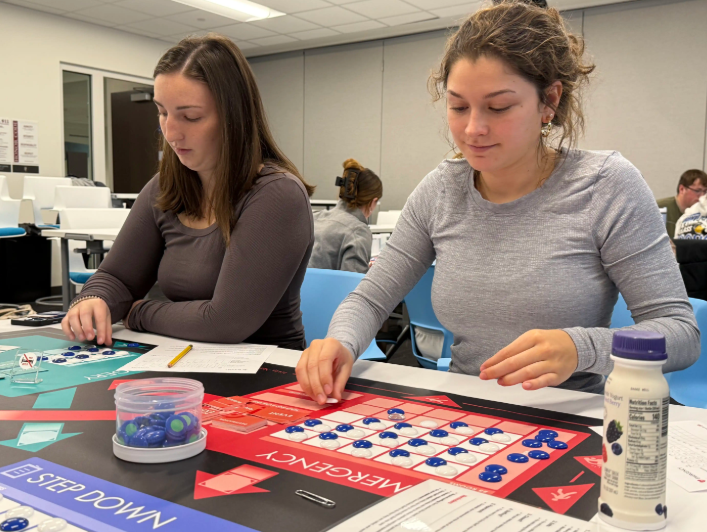
Both physical therapy and nursing students worked together to play “Friday Night at the ER.”
In her Innovation Grant application, Lori Hubbard, assistant professor of nursing and co-chair of the IPE Committee, emphasized the growing importance of interdisciplinary education in preparing students for professional practice. She noted that simulation-based learning experiences help students build confidence, communication skills and readiness for leadership positions in health care settings.
“Students in the School of Health Sciences at ÂÒÂ×ÊÓƵ are educated not just to become excellent professionals, but also to become leaders in their field,â€� Hubbard said. “Especially for our Nursing Fellows, this will help them get comfortable problem-solving and increase their awareness about tensions between quality and cost efficiency of care in today’s healthcare environment.â€�
Research on collaborative care models also supports the educational approach behind the simulation, Hubbard noted in her application.
“The research literature supports this contention that healthcare coordinated between disciplines through systems thinking can lead to better outcomes for patients,� Hubbard explained.
The game is part of a larger effort by the Interprofessional Education Committee and the Interprofessional Simulation Center to expand collaborative educational opportunities across the School of Health Sciences. Located in the Francis Center, the simulation center provides students with realistic clinical training environments that allow them to apply classroom knowledge in practical settings without leaving campus.
“Though any group can play ‘Friday Night at the ER’, this simulation experience seemed to be a natural fit for bringing nursing, physical therapy and physician assistant students together to work collaboratively through scenarios realistically encountered in the US healthcare system,� Hubbard said.
KEY TAKEAWAYS
- Simulations create leadership skills before graduation.
Experiential learning tools such as “Friday Night at the ER� expose students to real-world operational pressures in a low-risk environment. Universities can use simulation-based learning to strengthen decision-making, adaptability and leadership skills long before students enter the workforce. - Interdisciplinary learning mirrors modern workforce demands.
The exercise brought together nursing and physical therapy students to solve shared problems problems collaboratively. Higher education institutions can better prepare students for complex workplaces by designing programs that intentionally break down academic silos and encourage cross-disciplinary teamwork. - Innovation often starts with small, scalable investmentsÂ
A relatively modest Innovation Grant created a high-impact educational opportunity with long-term value for multiple academic programs. Universities do not always need major capital projects to advance innovation; targeted investments in creative teaching tools and faculty training can significantly enhance student learning outcomes.